
The Canadian 3D metrology market is projected to reach C$662.5 million by 2029, yet many local creators still feel locked out by the steep learning curve. You likely already know that 3D scanning is a game changer for design and repair, but the path forward is often cluttered with confusing jargon and high entry costs. Finding the right 3D scanner Canada has to offer shouldn't feel like a risky gamble for your workshop or business.
We're here to help you master the fundamentals of this technology so you can confidently select the hardware that fits your specific Canadian projects. Whether you're worried about software compatibility or trying to find professional gear that fits a realistic budget, this guide provides the clarity you need. We'll break down the core differences between scanner types, explore the best models for 2026, and show you how to find a dependable local source for hardware and ongoing support.
Key Takeaways
- Master the transition from physical geometry to digital data by understanding how point clouds become functional 3D meshes.
- Compare laser and structured light technologies to select the most effective 3D scanner Canada offers for your project's unique requirements.
- Navigate the budget framework for entry-level, mid-range, and professional hardware to ensure you get the best value for your investment.
- Streamline your workflow with professional tips on surface preparation and data acquisition to ensure high-quality CAD results every time.
- Eliminate "border headaches" and unexpected import duties by sourcing your technology from a dedicated Canadian specialist with local support.
What is a 3D Scanner and How Does it Benefit Canadians?
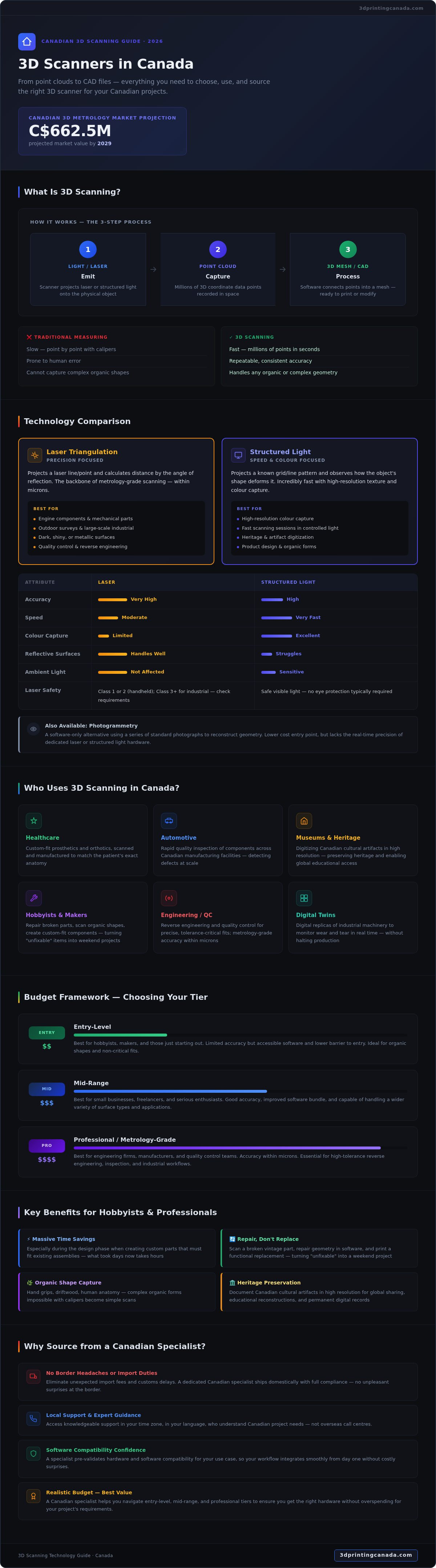
Imagine capturing the exact geometry of a physical part and seeing it appear on your screen in seconds. That is the core power of 3D scanning. At its simplest, What is 3D scanning? It's the process of using light or lasers to record the precise dimensions and shapes of physical objects, turning them into digital data. While a standard camera captures a flat, 2D image, a 3D scanner records the depth and volume of an object in three dimensions.
When you use a 3D scanner Canada professionals and hobbyists trust, the device first generates a "point cloud." This is a massive collection of individual data points in a 3D coordinate system. Your software then processes this swarm of points, connecting them to form a "mesh." This mesh acts as a digital skin, creating a surface that you can manipulate, measure, or send straight to a 3D printer. Unlike traditional manual measurement with calipers or tape measures, which is slow and prone to human error, scanning captures complex surfaces with incredible speed and repeatable accuracy.
Across Canada, diverse industries are already reaping these rewards. Healthcare providers use scanning to create custom-fit prosthetics, while automotive manufacturers across the country use it for rapid quality inspection. Even our national museums use this technology to digitize and preserve historical artifacts, ensuring our heritage remains accessible in a digital format forever.
The Bridge Between Physical and Digital
Scanning is the missing link in a modern maker's workflow. It allows you to take a real-world object and bring it into the digital space for modification. This is especially useful for "digital twins," which are digital replicas of industrial machinery used to monitor wear and tear without stopping production. For those focused on preservation, scanning helps document Canadian cultural artifacts in high resolution, creating a permanent record that can be shared globally or used for educational reconstructions.
Key Benefits for Hobbyists and Professionals
The practical advantages of owning a scanner are immediate. You'll realize massive time savings during the design phase, especially when creating custom parts that must fit into existing assemblies. Capturing organic shapes, like a hand grip or a piece of driftwood, is nearly impossible with manual tools but simple with a scanner. This technology also empowers you to repair rather than replace. If a plastic gear in a vintage appliance breaks, you can scan the pieces, fix the geometry in your software, and print a functional replacement. It turns "unfixable" items into simple weekend projects.
Understanding 3D Scanning Technologies: Laser vs. Structured Light
Choosing a 3D scanner Canada offers requires understanding the physics behind the lens. Most modern devices fall into two primary categories: laser triangulation and structured light. While both aim to create a digital replica of your object, they handle light and surfaces in very different ways. For those who don't need dedicated hardware yet, photogrammetry remains a software-based alternative that uses a series of standard photographs to reconstruct geometry, though it lacks the real-time precision of a physical scanner.
Laser triangulation works by projecting a laser line or point onto an object and using a camera to calculate the distance based on the angle of reflection. This technology is often the backbone of "metrology-grade" scanning. In engineering, metrology-grade refers to hardware that meets strict accuracy standards, often within microns, which is essential for quality control or reverse engineering mechanical parts. If your project requires high-tolerance fits, laser technology is usually the right path.
Laser Scanning: Precision in Varied Lighting
Laser scanners are the workhorses of the industrial world. They handle dark, shiny, or metallic surfaces much better than light-based sensors because the concentrated laser beam is easier for the scanner to "see" against a reflective background. You'll also find they're more reliable in various environments. Because they use a specific wavelength of light, they aren't easily confused by the overhead lights in your shop. Just ensure you check the laser safety class; most handheld units are Class 1 or 2, making them safe for general use, but high-power industrial units may require specific eye protection. These are best for engine components, outdoor surveys, or large-scale industrial objects.
Structured Light: Speed and High-Resolution Colour
Structured light scanners project a known pattern of lines or grids onto an object. The internal cameras observe how the object's shape deforms that pattern to calculate the geometry. This method is incredibly fast and is excellent at capturing high-resolution "texture" or colour data alongside the physical shape. However, this technology has a major limitation: it struggles in bright environments. Intense Canadian sunlight can wash out the projected pattern, making it difficult to get a clean read outdoors. These scanners are ideal for human scanning, historical art preservation, and small, intricate items with lots of surface detail. If you want to see these different technologies in action, you can browse our full selection of 3D scanners to compare their specific capabilities.
Choosing the Right 3D Scanner for Your Application
Finding the ideal 3D scanner Canada provides for your workshop depends entirely on what you plan to digitize. There is no single device that handles every task perfectly. The choice usually involves a trade-off between absolute precision and the freedom to move. While a high-end handheld unit offers incredible flexibility for large objects, a dedicated desktop scanner might provide the sub-millimetre detail required for mechanical engineering or fine jewellery design.
Budgeting for your hardware is your next step. Entry-level scanners are excellent for hobbyists who want to digitize simple shapes or master the software workflow. Mid-range options serve small businesses that need reliable accuracy for reverse engineering. Professional-grade hardware is built for industrial metrology, where every micron counts. Beyond the hardware, you must consider the software ecosystem. Most scanning programs require powerful Windows machines with dedicated GPUs to process point clouds in real-time. If you're a Mac user, your options are more limited, so verify compatibility before you invest in a 3D scanner Canada retailer stock.
Handheld Scanners for Maximum Versatility
Handheld scanners give you the freedom to walk around large objects. You can capture car bumpers, furniture, or even full human figures with ease. These devices rely on "tracking" to understand their position in space. They look for unique features on the object's surface or use adhesive reflective targets to maintain their orientation. This versatility makes them excellent for automotive customization or creating bespoke equipment. Many makers use these tools to design Bambu Lab accessories Canada enthusiasts use to personalize their setups, such as custom enclosures or tool holders that require a perfect fit onto the printer's frame.
Desktop Scanners for Small, Intricate Parts
Desktop scanners are the kings of consistency. They typically feature an automated turntable that rotates the object while the scanner remains fixed. This setup eliminates the "shaky hand" factor and ensures every angle is captured under controlled lighting. If you're working with jewellery, dental moulds, or small mechanical components, a desktop unit is often the superior choice. Because the distance between the lens and the object is constant, these units can often achieve higher resolution for tiny surface details that handheld models might skip. They turn complex, tiny parts into manageable digital meshes with minimal user intervention.
The 3D Scanning Workflow: From Physical Object to CAD File
Success with a 3D scanner Canada specialists recommend depends on your methodical approach. It isn't a magic wand; it's a precision instrument that requires a specific sequence of steps to produce usable data. The workflow begins long before you activate the sensors. You must first prepare the physical environment and the object itself to ensure the light or laser behaves predictably. Once the data is captured, the transition from a raw point cloud to a functional CAD file requires careful processing and an understanding of different file formats.
After the initial setup, you'll move through data acquisition, where you capture overlapping frames of the object. Your software then handles point cloud processing by cleaning up "noise" or stray data points and aligning the various scans into a single cohesive shape. The final stage is meshing, where the software connects the points to create a digital surface. This structured path ensures that your final digital model is accurate enough for professional engineering or creative projects.
Mastering Surface Preparation
Shiny, transparent, or deep black objects are the natural enemies of most scanners. These surfaces either absorb the light or scatter it so wildly that the cameras cannot calculate depth. To overcome this, use a vanishing scanning spray. These sprays create a temporary, ultra-thin matte white coating that provides the perfect surface for the scanner to read. The best part is that these coatings sublimate, meaning they evaporate on their own without leaving a residue or damaging delicate components. For flat, featureless surfaces like a car door, you should also apply adhesive tracking markers. These high-contrast dots give the scanner "anchors" to maintain its orientation as you move around the object.
Reverse Engineering for Practical Use
Capturing the shape is only half the battle. Most scanners produce an STL file, which is a mesh made of millions of tiny triangles. While an STL is perfect for direct 3D printing, it's difficult to modify in traditional CAD software. For true reverse engineering, you'll use the mesh as a "template" or "tracing layer" in programs like Fusion 360 to create a STEP file. A STEP file is a solid geometric model that allows you to add precise holes, threads, or structural changes with ease. This process is vital for recreating broken vintage parts or designing custom enclosures. If your hardware struggles during the subsequent manufacturing phase, 3D printer repair services Canada experts provide can help ensure your printer is calibrated to match your high-resolution scans.
Ready to bridge the gap between physical parts and digital design? Explore our range of 3D scanners and start your first reverse engineering project today.
Why Buy Your 3D Scanner from a Canadian Specialist?
Investing in a high-tech tool like a 3D scanner Canada makers use for complex reverse engineering is a significant step. While international marketplaces might look tempting at first glance, they often lead to what we call the "border headache." When you order from outside the country, you're frequently hit with surprise customs fees, brokerage charges, and import duties. These costs can add hundreds of dollars to your final bill unexpectedly. By choosing a Canadian specialist, the price you see is the price you pay. There are no hidden fees waiting for you at the doorstep.
Beyond the initial cost, there's the security of local warranty handling and repair services. If a component fails or your hardware needs a professional tune-up, you don't have to ship it across an ocean and wait months for its return. We handle support right here in Canada, ensuring your downtime is as short as possible. This local safety net provides peace of mind that international sellers simply can't match.
Expert Support and Community Knowledge
When you have a technical question, you want an answer from someone who actually uses the gear. A faceless international ticket system can't provide the same level of care as a knowledgeable mentor who understands your specific workflow. Our team provides peer-to-peer support that helps you get the most out of your new technology. We don't just sell scanners; we understand the entire making ecosystem, from the filaments you'll use for your final prints to the intricacies of 3D printer repair services. This holistic approach makes us a dependable partner in your creative success. We've seen the common pitfalls and can offer proactive solutions before you even start your first scan.
Fast National Shipping and Reliable Inventory
Waiting weeks for a package to clear a foreign warehouse can kill the momentum of any project. We maintain a robust online presence and a central Canadian hub to ensure fast national shipping. Having hardware in stock within Canada means you can start your project days after clicking "order." You also need the right consumables, like vanishing sprays and tracking markers, to begin scanning immediately. We keep these accessories in stock so you don't have to hunt for them elsewhere. Everything you need for a successful scan is available in one place, ready to ship to your door.
Ready to bring your physical objects into the digital world? Explore our collection of 3D scanners and start your next project with the support of a local expert.
Bring Your Digital Vision to Life
Selecting the ideal 3D scanner Canada offers is about finding the perfect balance between your project goals and the right technical specifications. You've learned how to distinguish between laser and structured light systems, and you understand the workflow required to move from a physical object to a clean CAD file. Whether you are a hobbyist repairing vintage parts or a professional focused on industrial metrology, the tools to digitize your world are more accessible than ever before.
Avoid the uncertainty of international orders by partnering with a local specialist. As an authorized dealer for top hardware brands, we provide fast national shipping across Canada and expert technical support from our Hamilton-based team. We're here to ensure your hardware stays calibrated and your projects stay on track. Browse our full range of 3D Scanners at 3D Printing Canada to find the hardware that fits your workshop. Your journey into high-precision digitizing starts here, and we can't wait to help you succeed.
Frequently Asked Questions
Do I need a powerful computer to use a 3D scanner in Canada?
You definitely need a robust computer to handle the real-time data processing required by a 3D scanner Canada retailers sell. Most scanning software relies heavily on a dedicated NVIDIA GPU and at least 16GB to 32GB of RAM to render point clouds without lag. If your system is underpowered, the software may drop frames, leading to poor alignment and a frustrating user experience during the capture phase.
Can I 3D scan a person with these handheld devices?
Yes, you can scan people, but you must ensure the device uses eye-safe technology like structured light or infrared. Many handheld models are designed specifically for body scanning to create custom prosthetics or digital avatars. Always check the manufacturer's safety rating to confirm the light source won't cause discomfort or harm during a face scan. It's a common practice in the Canadian medical and film industries.
What is the best 3D scanner for beginners on a budget?
The best entry-level choice is typically a prosumer structured light scanner that balances ease of use with decent resolution. Look for "plug-and-play" models that offer automated meshing features to simplify the learning curve for new users. While professional metrology gear is a significant investment, the prosumer market now offers impressive accuracy for hobbyist budgets and small workshop projects without requiring industrial-grade spending.
Is 3D scanning software usually included with the hardware?
Basic capture and meshing software is almost always included with your hardware purchase at no extra cost. This proprietary software allows you to calibrate the device, capture raw data, and export a standard mesh file like an STL. However, if you need advanced reverse engineering tools to turn those meshes into editable solid CAD models, you might need to invest in separate third-party software licenses later on.
Can I scan an object and 3D print it immediately?
You can't usually print immediately because raw scan data often contains "holes" or noise that a 3D printer can't interpret. You first need to use the software to create a "watertight" mesh, which fills in any gaps in the geometry. Once the mesh is manifold and clean, you can slice it and send it to your printer just like any other digital 3D model you've downloaded.
How accurate are modern handheld 3D scanners?
Modern handheld units are incredibly precise, with many prosumer models achieving an accuracy between 0.05mm and 0.1mm. Professional industrial scanners can go even further, reaching tolerances measured in microns for high-stakes engineering. For most Canadian makers, a standard handheld 3D scanner Canada specialist shops provide is more than accurate enough for reverse engineering car parts or creating custom enclosures that require a snug, professional fit.
Do 3D scanners work outdoors in Canadian weather?
Standard structured light scanners struggle in bright sunlight because the ambient light washes out the projected patterns. If you need to work outside, a laser-based system is a much more reliable choice for consistent data. You should also be mindful of extreme temperatures; very cold weather can affect battery life and sensor calibration, so it's best to scan in a controlled indoor environment whenever your project allows.
What is the difference between photogrammetry and 3D scanning?
Photogrammetry uses a series of standard 2D photographs and software algorithms to reconstruct 3D geometry, whereas 3D scanning uses dedicated sensors like lasers to measure depth directly. Scanning is generally faster and more accurate for mechanical parts that require tight tolerances. Photogrammetry is a great low-cost starting point for artistic projects, but it often lacks the precision required for functional engineering or manufacturing tasks.