
What if you could capture a professional-grade digital twin of a complex mechanical part or a delicate sculpture in less time than it takes to brew a morning coffee? For many Canadian creators, finding the right handheld 3D scanner Canada has often felt like a choice between a bank-breaking industrial unit and a hobbyist tool that simply doesn't deliver the resolution you need. You've likely felt the frustration of staring at a digital mesh that looks more like a melted candle than your original object. We know that the leap into 3D scanning feels intimidating when you're trying to figure out if structured light or LiDAR technology will actually work for your specific project.
It's time to simplify the process and get you scanning with confidence. This 2026 guide helps you master portable technology by matching the right hardware to your unique workflow. Whether you're looking for seamless integration with your 3D printing setup or reliable Canadian technical support to back your investment, we're here to help you organize your approach. We'll break down the latest 2026 standards, show you how to capture every colour and detail, and compare entry-level versus metrology-grade performance to ensure you get the best value for your project.
Key Takeaways
- Decode how portable scanners utilize light and laser patterns to transform physical objects into precise digital models for your creative projects.
- Distinguish between accuracy and resolution to choose a device that delivers the fine detail required for professional engravings and mechanical parts.
- Find the ideal handheld 3D scanner Canada by evaluating the performance gap between hobbyist-grade tools and high-speed professional hardware.
- Explore practical ways to utilize scanning for reverse engineering obsolete machinery parts or creating perfectly fitted custom accessories.
- Learn how to leverage expert technical support and local curation to ensure your new scanner works seamlessly with your existing filaments and 3D printing workflow.
Understanding Handheld 3D Scanning Technology
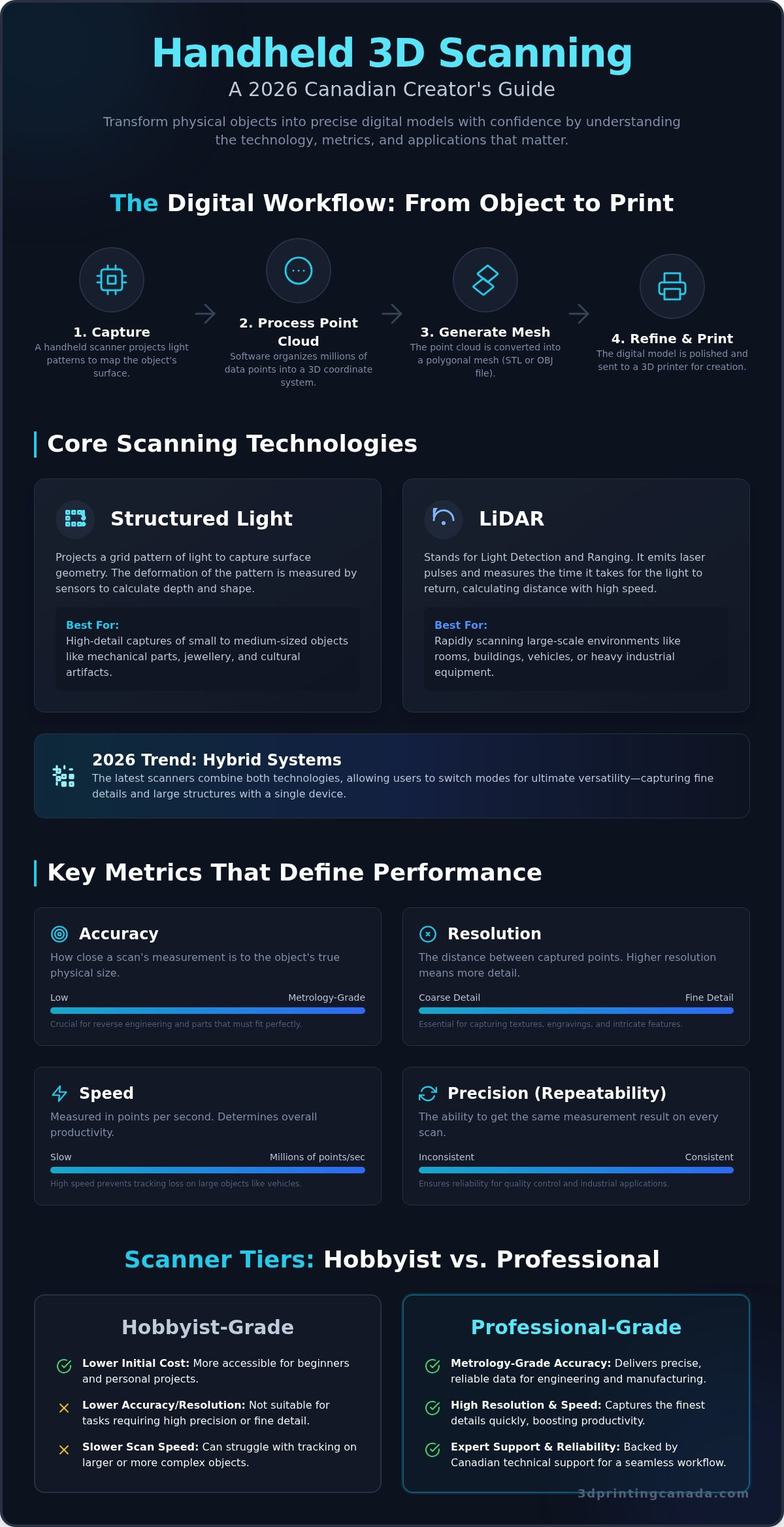
A handheld 3D scanner Canada acts as a high-speed bridge between physical objects and digital design environments. At its core, 3D scanning technology uses light or lasers to capture the precise geometry of an item. These devices project a specific pattern or beam onto a surface. As the light hits the object, it deforms based on the shape and depth of the part. Internal sensors then measure these deformations to calculate thousands of data points every second. By 2026, these tools have become the standard for Canadian professionals because they offer industrial-grade precision in a package that fits in your gear bag.
Think of the software as the brain of the operation. While the sensors do the hard work of seeing the object, the software is what organizes that chaotic data into a usable model. It filters out noise, aligns multiple scan angles, and ensures the final file is watertight. In 2026, the best scanners are defined by their software's ability to handle complex data without requiring a supercomputer. This accessibility allows local creators to find a handheld 3D scanner Canada that fits their specific budget and performance needs. It ensures that your hardware remains a productive tool rather than an intimidating obstacle.
Structured Light vs. LiDAR: Which Is Right for You?
Choosing between technologies depends entirely on your project's scale. Structured light scanners project a grid of light and are perfect for high-detail captures like engine components or jewellery. If you need to map a large room or a piece of heavy equipment quickly, LiDAR (Light Detection and Ranging) is your best bet. We're seeing a massive trend in 2026 toward hybrid systems. These units combine both technologies, allowing you to switch modes based on the detail level you require without needing multiple devices. This versatility makes them a favourite for Canadian shops that handle everything from small prototypes to large-scale industrial repairs.
The Scanner-to-Print Workflow
Getting from a physical object to a finished 3D print involves a specific digital journey. Your scanner first creates a raw point cloud, which is a massive collection of individual coordinates in space. You'll then use software to convert this cloud into a mesh, typically an STL or OBJ file. Don't expect a perfect model immediately. Even the best scans usually require a bit of digital polish to close holes or smooth surfaces. This refined mesh can then be imported into CAD software for reverse engineering projects or sent directly to your printer to be realized in your favourite filament.
Accuracy, Resolution, and Speed: The Core Metrics
Specs on a datasheet often look like a wall of confusing numbers, but they dictate whether your project succeeds or fails. When you invest in a handheld 3D scanner Canada, you need to look past the marketing jargon and focus on three pillars: accuracy, resolution, and speed. These metrics determine if a replacement gear will actually mesh with an old engine or if a digital sculpture will look like a blobby mess. Understanding these details helps you choose a tool that matches your specific workflow requirements.
Accuracy and precision are often used interchangeably, but they mean very different things in a professional context. Accuracy is how close your digital measurement is to the object's true physical size. Precision, or repeatability, is the scanner's ability to provide that same measurement every single time you pull the trigger. Resolution is a separate beast entirely. It defines the distance between the points in your scan. If you're capturing fine engravings or the grain of a wood carving, high resolution is your best friend. Without it, those micro-details simply disappear into a smooth, featureless surface.
Scanning speed, measured in points per second, is the engine that drives your productivity. If you're scanning a small bracket, speed isn't a dealbreaker. However, if you're walking around a full-sized vehicle, a slow scanner will lose tracking and force you to restart constantly. High-speed units capture millions of points per second, allowing for a fluid, natural movement. To keep these metrics consistent, you must prioritize calibration. Regular checks with a manufacturer-provided calibration board ensure your hardware hasn't drifted out of spec due to temperature shifts or a bumpy ride in your truck. If you ever feel your results are drifting, our team provides expert technical support to help you get back on track.
Metrology-Grade Scanning for Engineering
Metrology-grade tools are designed for environments where "close enough" isn't an option. These scanners are built with high-end optics and thermal compensation to ensure the data is legally and technically defensible for quality control. Metrology-grade accuracy is defined as a measurement under 0.05mm. This extreme level of detail ensures that your scanned part will fit perfectly with existing mechanical components, saving you hours of trial and error in the workshop.
Colour and Texture Capture
RGB scanning captures the visual "skin" of an object alongside its geometry. This is essential for creators in the gaming and CGI industries who need photorealistic digital assets. It's also a game-changer for heritage preservation, allowing museums to archive artifacts in full colour. Keep in mind that lighting is your biggest variable here. Uneven shadows or harsh glares can ruin a texture map, so always aim for a neutral, well-lit environment to get the most out of your sensors.
Comparing Hobbyist vs. Professional Handheld Scanners
The landscape for finding a handheld 3D scanner Canada has shifted dramatically in 2026. Gone are the days when you only had two choices: a cheap toy or a device that costs as much as a new SUV. We now see a massive "prosumer" gap where mid-range scanners offer incredible performance for a fraction of the traditional cost. This evolution means you can now find a tool that aligns perfectly with your specific project goals without overpaying for features you'll never use. Understanding where your needs sit on this spectrum is the first step toward a successful investment.
Entry-level scanners have become remarkably capable for the casual user. These devices prioritize plug-and-play functionality, making them a fantastic starting point for students or artists. If you want to customize Bambu Lab accessories or create unique digital assets for gaming, a hobbyist unit is often plenty of hardware. However, these scanners still struggle with shiny or jet-black surfaces. You'll often need to use scanning sprays to help the sensors see the geometry, which adds a small extra step to your workflow. They are perfect for learning the ropes of 3D data capture before moving into more demanding industrial applications.
Professional scanners are built for the rigours of daily use in Canadian workshops and design studios. These units feature industrial-grade sensors that can handle complex lighting and difficult materials with ease. The real value, however, lies in the software. Professional tools include advanced features for automatic mesh alignment and intelligent hole filling, which can save you hours of manual cleanup. Because these units are precision instruments, they require a higher level of care. Just as you'd rely on professional 3D printer repair services to keep your production line moving, your professional scanner needs a reliable support system to maintain its accuracy over time.
When you evaluate a handheld 3D scanner Canada, remember to look beyond the initial purchase price. Total cost of ownership includes software subscriptions, which are common for high-end metrology tools. You also need to consider your hardware environment. Most 2026 scanning software requires a dedicated NVIDIA GPU and at least 32GB of RAM to process large data sets smoothly. Factor in these hidden costs to ensure your new scanner doesn't sit idle because your computer can't keep up with the data flow. By planning for the entire ecosystem, you'll realize much better results and a faster return on your investment.
Practical Applications for Handheld Scanning in Canada
The versatility of a handheld 3D scanner Canada extends far beyond simple hobbyist curiosity. In 2026, these devices have become essential tools for solving complex logistical and creative challenges across the country. From the industrial shops of the Prairies to the design studios in the Maritimes, portable scanning allows professionals to capture physical reality and bring it into a digital space where it can be modified, archived, or replicated. This workflow is transforming how we approach maintenance and creation in every sector.
Reverse Engineering and Industrial Repair
One of the most immediate benefits for Canadian small businesses is the ability to recreate obsolete or broken machinery parts. When a critical component fails on an old tractor or a custom manufacturing line, waiting weeks for a replacement part isn't an option. By scanning the broken part, you can create a digital blueprint for a replacement. This part can then be printed on-site using high-strength filaments like carbon-fibre reinforced nylon. This localized production shortens the supply chain and significantly reduces downtime, keeping local operations running smoothly without the need for expensive international shipping.
Creative Design and Digital Art
For the artistic community, handheld scanners serve as a powerful foundation for digital sculpting. Instead of starting from a blank sphere in ZBrush or Blender, artists scan physical maquettes or found objects to use as a base. This hybrid approach allows for a level of organic detail that is difficult to achieve by hand alone. It's also becoming a standard practice for preserving historical artefacts. By creating a permanent digital record, museums can share detailed 3D models of delicate items with researchers worldwide without risking damage to the original piece.
The same technology is revolutionizing healthcare through custom orthotics and prosthetics. Precise body scans allow clinicians to design supports that match a patient's unique anatomy with sub-millimetre accuracy. This level of customization ensures better comfort and faster recovery times. Whether you're designing wearable tech or repairing heavy machinery, having the right tools is only half the battle. You also need a partner who understands the additive manufacturing ecosystem. If you're ready to upgrade your workflow, explore our curated selection of 3D scanners to find the perfect fit for your next project.
Why Source Your Handheld 3D Scanner from 3D Printing Canada?
Finding the right handheld 3D scanner Canada shouldn't feel like a gamble. At 3D Printing Canada, we act as your technical partner to ensure the hardware you choose actually solves the problems you face in your workshop or studio. Our expert curation means every scanner in our inventory has been put through its paces by our own team. If it doesn't meet our rigorous standards for reliability and ease of use, it doesn't make it onto our shelves. We don't just sell you a box; we provide the mentorship required to help you realize your most ambitious projects from the very first scan.
We offer a complete additive manufacturing ecosystem that most retailers simply can't match. We understand that scanning is only the first step in a much larger workflow. Whether you need the perfect filament to bring your digital model to life or professional 3D printer repair to keep your production line moving, we have the infrastructure to support you. This holistic approach ensures that your investment in scanning technology translates into tangible results with minimal downtime. We're here to help you bridge the gap between a digital mesh and a physical part.
Support That Goes Beyond the Sale
When you run into a calibration hurdle or a software glitch, you need a local expert who understands the nuances of your specific device. Our in-house technicians provide troubleshooting and advice that you won't find on a generic support forum. We help you organize your workflow and refine your scanning technique to ensure you're getting the highest resolution possible. It's a community-oriented approach that values your creative success and keeps your projects moving forward without unnecessary delays or frustration.
Investing in the Future of Canadian Innovation
By sourcing your gear from a domestic hub, you're supporting a business that is deeply invested in the Canadian maker community. We stay at the forefront of 3D scanner technology to bring you the latest 2026 advancements as they happen. With fast, reliable shipping from our central hub to every corner of the country, we make professional-grade tools accessible to everyone from coast to coast. Browse our full range of handheld 3D scanners today!
Elevate Your Creative Workflow with Portable Scanning
Mastering portable 3D scanning is about finding the right balance between accuracy, resolution, and ease of use for your specific project. Whether you're reverse engineering industrial parts or digitizing delicate art, 2026 technology makes professional results accessible to everyone. By choosing a handheld 3D scanner Canada through a partner that understands the entire additive manufacturing ecosystem, you ensure every captured point cloud translates into a successful final print.
We back your investment with expert technical support from experienced Canadian technicians and comprehensive repair services to keep your hardware in peak condition. Our team prioritizes fast nationwide shipping from our central hub so you can start scanning without unnecessary delays. Find your perfect handheld 3D scanner at 3D Printing Canada and start turning your physical ideas into digital reality today. We're ready to help you realize your next big project.
Frequently Asked Questions
How accurate is a handheld 3D scanner compared to a desktop version?
Handheld scanners in 2026 often match the accuracy of traditional desktop units for most professional applications. While high-end desktop scanners provide a controlled environment for tiny items, a professional handheld 3D scanner Canada can achieve metrology-grade accuracy of less than 0.05mm. This portability allows you to capture large or fixed components that wouldn't fit on a turntable, providing a more versatile solution for complex engineering and design tasks across the country.
Can I scan dark or shiny objects with a portable 3D scanner?
Modern scanners equipped with blue laser or hybrid light technology handle dark and reflective surfaces much better than older models. However, for jet-black or mirror-finish parts, we still recommend using a specialized scanning spray. These sprays create a temporary matte white coating that allows the sensors to capture geometry with perfect precision. Once you finish the scan, the coating simply evaporates or wipes away without damaging your original object or leaving a residue.
What kind of computer do I need to run 3D scanning software in 2026?
Processing millions of data points requires significant hardware power. For a smooth 2026 workflow, you'll need a computer with a dedicated NVIDIA GPU and at least 32GB of RAM. High-speed SSD storage is also essential for handling the large file sizes generated during high-resolution captures. If your current system feels sluggish during the mesh alignment phase, upgrading these core components will drastically reduce your overall project time and prevent software crashes during complex scans.
Do I need to pay for a software subscription to use my scanner?
Software costs vary significantly between brands. Many hobbyist and prosumer scanners include perpetual licenses for their proprietary software with no recurring fees. In contrast, industrial metrology-grade units often require an annual subscription to access advanced reverse engineering tools and regular firmware updates. Always check the licensing terms before you buy to ensure the long-term cost of ownership aligns with your business budget and the frequency of your professional scanning projects.
Is it possible to 3D print a scan directly without editing?
While it's technically possible, we don't recommend printing a raw scan without some digital cleanup. Scanners often capture digital noise or leave small holes in the mesh that can cause your 3D printer to fail. You'll typically use software to make the model watertight and optimize the geometry for printing. This brief processing step ensures a much higher success rate when you finally load your chosen filaments into your printer to realize the physical part.
What is the best handheld 3D scanner for reverse engineering in Canada?
The best handheld 3D scanner Canada for reverse engineering is one that offers high accuracy and seamless CAD integration. For most Canadian professionals, a hybrid laser scanner provides the best balance of speed and detail for mechanical parts. We curate our selection to include hardware that handles complex geometries and provides clean data for your design software. Our team can help you select a model that specifically fits your industrial repair or manufacturing workflow.
How long does it take to complete a full 3D scan of a medium-sized object?
Capturing the raw data for a medium-sized object, such as a car manifold or a large bust, usually takes between 5 and 15 minutes. The actual scanning is quite fast; the majority of your time is spent in the software phase. Processing the point cloud into a refined, watertight mesh can take an additional 20 to 40 minutes depending on your computer's speed and the level of detail you require for the final file production.
Does 3D Printing Canada offer training for new scanner owners?
We provide expert technical support and mentorship to help you get the most out of your new hardware. While we don't offer formal classroom certifications, our experienced Canadian technicians are available to guide you through the initial setup, calibration, and troubleshooting process. We believe in being a helpful local resource, ensuring you have the knowledge and support required to turn your sophisticated scanning tools into a productive part of your creative or industrial ecosystem.