
Your brand-new 600mm/s printer is little more than a fast way to produce weak, brittle parts if you're feeding it the wrong material. It's incredibly frustrating to watch a high-end machine struggle with under-extrusion or poor layer adhesion just because the plastic can't melt and cool fast enough to keep up with the toolhead. You want the speed you paid for, but you also need parts that don't snap the moment you put them to use. Finding reliable high speed filament Canada wide shouldn't feel like a gamble with your print quality or your shipping budget.
We understand that mastering rapid production requires a perfect synergy between hardware and material science. This guide will help you master the selection and settings needed to unlock your printer's full potential without sacrificing part strength. You'll learn how to achieve successful prints at 300mm/s and beyond while maintaining a consistent colour and professional finish at high flow rates. We'll also highlight how to source bulk materials from a dependable Canadian partner to keep your workshop running efficiently. Let's get your settings dialed in and your print times slashed.
Key Takeaways
- Understand how a high Melt Flow Index (MFI) and specialized additives prevent under-extrusion by lowering viscosity at the hotend.
- Realize better mechanical properties by choosing filaments designed to maintain layer adhesion even at velocities exceeding 300mm/s.
- Optimize your machine with high-flow nozzles and specific slicer profiles to eliminate the "speed wall" that holds back standard materials.
- Secure a reliable supply of high speed filament Canada wide to ensure consistent colour and finish for your rapid production projects.
- Reduce your per-spool costs by leveraging bulk purchasing and local technical support tailored for Canadian print farms and hobbyists.
What is High-Speed Filament and Why Does It Matter?
High-speed filament isn't just standard plastic in a flashy box. It's a fundamental shift in how 3D printing filament is engineered for modern machines. While traditional materials are designed for steady, predictable extrusion, high-speed variants feature optimized rheology. This means the plastic flows more efficiently when molten and solidifies rapidly once it leaves the nozzle. As the adoption of rapid machines has skyrocketed across the country, the demand for high speed filament Canada wide has moved from a niche hobbyist requirement to a professional necessity.
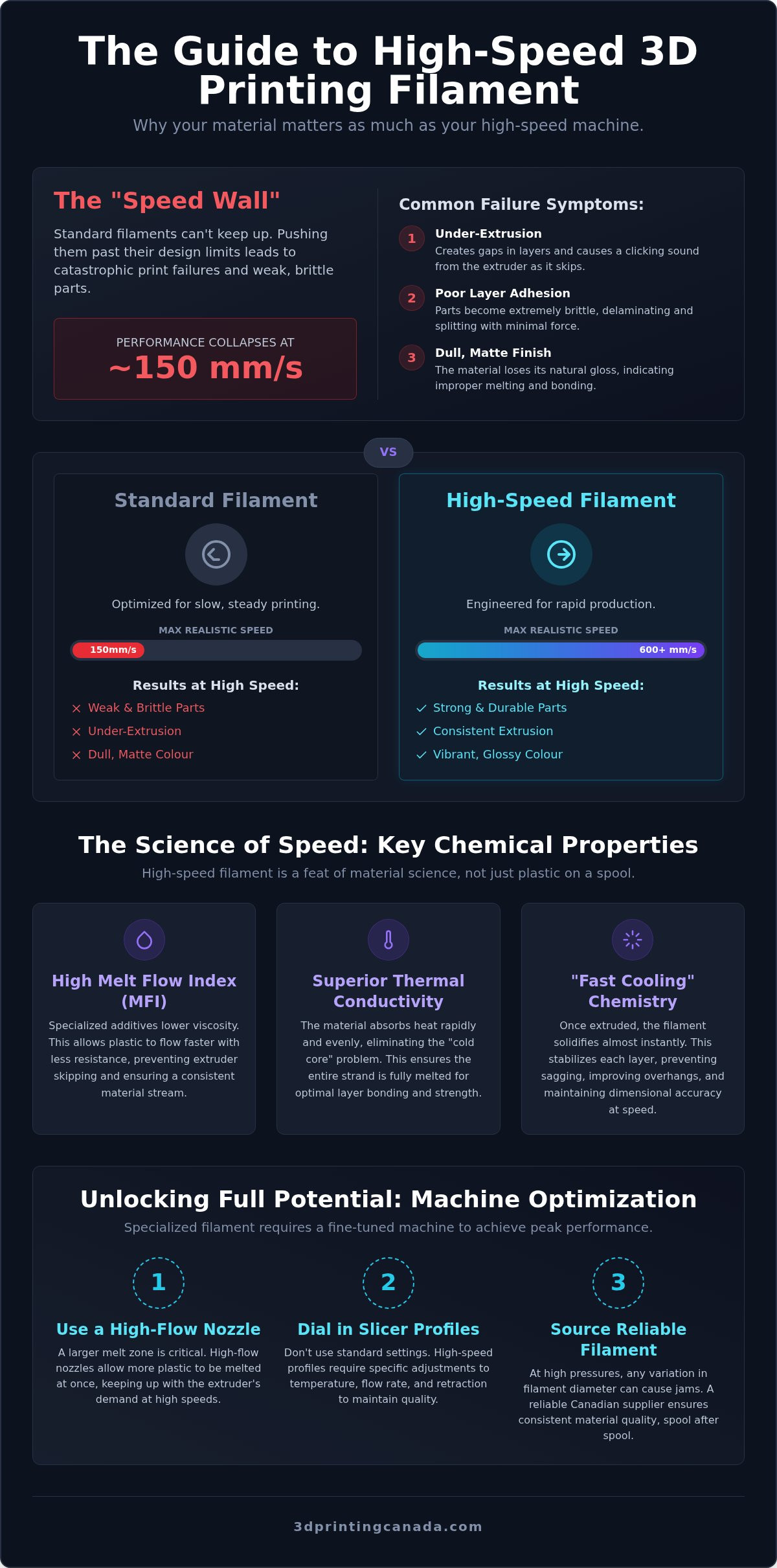
Most makers hit the "speed wall" at about 150mm/s. At this point, standard materials can't absorb heat fast enough to melt the core of the strand. High-speed filament solves this through specialized polymer blends that melt faster and maintain structural integrity even when printed at triple traditional velocities. The primary benefits are clear: you'll save massive amounts of time on large projects, achieve a better surface finish, and ensure your parts don't lose their strength just because they were printed quickly.
The Problem with Standard Filaments at High Velocity
When you push a regular spool past its limits, you'll notice more than just failed prints. Under-extrusion is the first sign, often accompanied by a distinct clicking sound as your extruder gears skip against the resistant plastic. You'll also see a noticeable change in aesthetics. Standard PLA often loses its natural gloss, turning matte and brittle as the layer bonding weakens. For most standard spools, things start to fall apart once you cross the 150 to 200mm/s threshold. This leaves you with parts that look poor and break under the slightest pressure.
The Evolution of High-Speed Materials in 2026
By 2026, manufacturers have completely overhauled their chemical formulations to keep pace with the latest fast 3d printer Canada models. We now see "Hyper" and "High-Flow" branding as the standard for professional-grade work. These 2026 formulations allow for consistent production at speeds exceeding 500mm/s. Speed is now the baseline expectation for professional print farms. These materials ensure that even at extreme velocities, the internal bonds remain strong and the colour remains vibrant. It's no longer about choosing between speed and quality; modern high speed filament Canada options let you have both.
The Science Behind the Spool: How High-Speed Filament Works
Printing fast is more than just a hardware challenge. It's a complex dance of chemistry and physics. Rheology is the study of how matter flows, specifically focusing on the transition from solid filament to liquid melt in the nozzle. To achieve the results you want, you need to understand the Melt Flow Index (MFI). A higher MFI is crucial for rapid extrusion because it measures how much material can be pushed through the nozzle at a specific temperature and pressure. High-speed filaments utilize specialized additives that decrease the polymer’s viscosity when molten. This allows your extruder to push more plastic with less resistance, preventing the motor from stalling or grinding the filament.
Recent research on 3D printing bottlenecks shows that thermal transfer is a major hurdle when trying to increase output. Standard plastics often leave the nozzle with a "cold core" because they can't absorb heat fast enough. This leads to poor bonding and brittle parts. High-speed materials are formulated with "fast cooling" chemistry that allows the plastic to set almost instantly after it hits the build plate. This ensures the previous layer is stable before the next one arrives, which is why choosing the right high speed filament Canada has to offer is the first step toward professional-grade rapid production.
Melt Flow and Thermal Conductivity
High-speed filaments are engineered to absorb heat much faster than standard materials. This increased thermal conductivity ensures the entire strand reaches the required melting temperature as it zips through the hotend. Consistency is king here. A precise and consistent diameter is essential to prevent flow fluctuations at high pressure. Thermal conductivity remains the "secret sauce" for maintaining layer adhesion. Without it, your parts might look great on the outside but will lack the internal strength needed for functional use. If you want to see these physics in action, check out our selection of filaments designed for high-flow performance.
Crystallization and Part Cooling
Speed creates a unique cooling dilemma. If the plastic stays in a molten state for too long, your print will slump and lose its crisp detail. Faster crystallization prevents this slumping during rapid moves. This creates a powerful synergy with the high-output cooling fans found on modern machines like the Bambu Lab series. By using materials designed for quick solidification, you can realize better overhangs and sharper bridges. You won't have to sacrifice the geometry of your design just to save a few hours on the print bed. This rapid phase change is exactly what makes high speed filament Canada a superior choice for time-sensitive projects.
High-Speed vs. Standard Filament: A Performance Comparison
Choosing between standard and specialized spools often comes down to a simple cost-to-performance calculation. While a standard roll might save you a few dollars upfront, the time saved by using high speed filament Canada options usually outweighs the initial expense. If you can cut a twelve-hour print down to five hours, your machine is free for the next job sooner. Beyond time, there is the matter of strength. Standard PLA often fails at high velocities because the core stays semi-solid, leading to hollow or weak extrusions. High-speed variants are engineered to produce stronger parts at 300mm/s than standard materials can manage at much lower speeds.
The aesthetic difference is equally striking. Pushing regular plastic too fast results in a washed-out, matte finish as the polymer chains are stretched beyond their thermal capacity. Modern high-speed blends maintain deep colour vibrancy and consistent surface finishes, whether you prefer a silk or matte look. We've also seen the industry move past the "brittleness" myth. Early rapid-prototyping materials were prone to snapping, but 2026 formulations utilize advanced impact modifiers. Understanding the science of high-speed thermoplastic materials helps us realize how these modifiers preserve flexibility without losing rigidity.
Flow Rate Benchmarking
To see the real-world difference, you need to look at volumetric flow rather than just travel speed. Conduct a Max Volumetric Flow test (measured in mm³/s) to find your material's true limit. Standard PLA typically tops out between 12 and 15 mm³/s. In contrast, high-speed PLA easily reaches 25 to 35 mm³/s. These numbers are the real indicators of how much plastic your hotend can actually melt and move. If your flow rate is too low, increasing your travel speed won't actually result in faster prints.
Layer Adhesion and Structural Integrity
Layer adhesion is where high-speed filaments truly shine. When a nozzle moves too fast with standard filament, it fails to melt the surface of the previous layer, resulting in "cold" joints. High-speed blends ensure a reliable chemical bond even with extremely short contact times. This isn't limited to just rigid plastics. You can also master TPU filament in Canada for flexible high-speed needs, ensuring that even your elastic parts remain durable when printed at pace. Reliable bonding means your rapid prints are functional, not just fast.
How to Optimize Your Printer for High-Speed Materials
Loading a spool of high speed filament Canada into your machine is just the first step. To truly realize the benefits of rapid production, your hardware and software must be perfectly in sync. High acceleration forces can easily dislodge a part that isn't secured properly, making bed adhesion more critical than ever. Follow this five-step checklist to ensure a smooth transition: clean your build plate thoroughly, check your belt tension for slack, install a high-flow nozzle, update your slicer’s volumetric limits, and run a fresh flow calibration. These small steps prevent the most common failures when pushing your machine to its limits.
Standard brass nozzles often struggle to transfer heat fast enough at high volumes. You'll likely need a hardened steel or specialized bimetal nozzle to maintain consistent temperatures. When adjusting your slicer, don't just crank up the "travel speed" and hope for the best. You need to match your "Infill" and "Wall" speeds to the material's actual flow capabilities. If you're seeing gaps in your walls, it's a sign that your hardware can't keep up with the software's demands. Consistency in these settings is what separates a failed prototype from a successful production run.
Hardware Requirements for Speed
If you're using a modern machine, you might need specific Bambu Lab accessories in Canada like a 0.4mm High-Flow hotend to maximize your throughput. Hardware optimization also involves vibration compensation, often called Input Shaping. This technology cancels out the resonances caused by fast movements, ensuring your quality doesn't suffer as you speed up. Ensure your extruder tension is properly adjusted. If it's too loose, the filament will slip during high-pressure extrusion; if it's too tight, you'll grind the material and cause a jam. Proper tension ensures that every millimetre of plastic is accounted for.
Slicer Tuning and Calibration
Calibration is where you'll find the extra 10% of performance. Start by tuning your Pressure Advance, or Flow Dynamics, to ensure corners stay sharp and extrusions start and stop precisely. High-speed filament often requires a temperature increase of 10 to 20°C compared to standard settings to maintain the necessary fluidity. Finally, test your cooling limits. While modern fans are powerful, printing too fast can still lead to "ghosting" or "ringing" on the part surface if the plastic doesn't set instantly. Once your machine is dialed in, shop our high-speed filaments to put your calibration to the test.
Finding the Best High-Speed Filament in Canada
Finding the right supplier is just as important as finding the right material. When you're looking for high speed filament Canada, you need a partner that provides more than just a box of plastic. Local technical support ensures that if your settings drift or your prints start failing, you have someone to call who understands the hardware. Fast nationwide shipping is the lifeblood of any print farm or small business. Waiting weeks for a spool from overseas can kill your productivity. Buying in bulk is another strategy for success. It significantly reduces your per-spool cost and ensures colour consistency across large production runs.
At 3D Printing Canada, we curate our selection based on rigorous testing. Searching for the best high speed filament Canada offers means looking for a supplier that understands the technical demands of your specific hardware. We ensure every brand we carry performs well in our unique climate and on the most popular machines. Whether you're running a Bambu Lab X1C, a Creality K1, or a custom-built Voron, your material choice should reflect your machine's specific kinematics. An informed purchase is the best way to avoid the headaches of under-extrusion and layer failure.
Top High-Speed Brands to Consider
You have several excellent options when selecting a rapid material. Bambu Lab PLA Basic is a fantastic starting point for those integrated into that specific ecosystem. However, specialized third-party HyperPLA often provides better value or unique aesthetic finishes. Our house-brand filaments are a point of pride. We've optimized them to balance high velocity with affordable pricing for the Canadian market. For those in industrial sectors, carbon-fibre blends are now available for high-speed applications. These materials provide the stiffness and heat resistance required for functional prototypes without forcing you to slow down your print speeds.
Why Choose a Specialized Canadian Retailer?
The advantage of a local expert goes beyond the sales floor. If your high-speed setup runs into hardware trouble, having access to professional 3D printer repair services in Canada is invaluable. High-speed printing puts more wear on components like belts, bearings, and nozzles. We understand these unique challenges and provide the parts and knowledge to keep you running. Our fast shipping across the country ensures your production lines never stall. You get access to advice that understands the Canadian making community's needs. We're here to help you solve problems and keep your printers moving at top speed.
Take Your Production into the Fast Lane
Mastering rapid 3D printing requires more than just a fast machine; it's about the synergy between your hardware and the material you feed it. You've learned how specialized rheology and high Melt Flow Index ratings prevent under-extrusion at extreme velocities. By optimizing your slicer settings and upgrading to high-flow nozzles, you can finally realize those 300mm/s+ targets without compromising on part strength, colour, or surface quality. Finding the right high speed filament Canada offers is the final piece of the puzzle for consistent, professional results.
We're here to support every step of your journey. As an authorized Bambu Lab retailer with expert technical support, we ensure you have the right tools and the knowledge to use them effectively. Don't let your production stall while waiting for materials from across the border. Take advantage of our fast nationwide shipping and stock up on the industry's best spools today. Shop High-Speed Filaments at 3D Printing Canada and start printing at top speed with total confidence. Happy printing!
Frequently Asked Questions
Do I really need high-speed filament for my Bambu Lab printer?
You definitely need it if you want to print at the machine's maximum rated speeds without losing quality. Standard filaments often hit a thermal limit around 150mm/s. Using high-speed variants ensures consistent extrusion and reliable layer bonding at 300mm/s and beyond. It prevents the under-extrusion issues that lead to brittle parts and surface defects when your machine is moving faster than the plastic can melt.
Can I use high-speed filament on an older, slower 3D printer?
Yes, you can use these materials on any FDM printer. While an older machine won't hit 500mm/s, the improved rheology of the filament often results in more consistent extrusion and better surface finishes even at 60mm/s. It's a great way to ensure reliable flow if your hotend has limited heating capacity. You don't need a state-of-the-art machine to benefit from the advanced chemistry of modern spools.
Is high-speed filament more expensive than regular PLA in Canada?
The price gap has narrowed significantly. While specialized spools occasionally carry a small premium, the time savings usually make them more cost-effective for professional production. You'll find that bulk high speed filament Canada pricing is very competitive with standard PLA. Always consider the total cost per print hour rather than just the price per kilogram. Cutting print times in half effectively doubles your machine's value.
What temperature should I use for high-speed PLA?
You should typically increase your nozzle temperature by 10 to 20 degrees Celsius compared to standard PLA settings. This extra heat is necessary to melt the core of the filament as it zips through the hotend at high velocity. Most high-speed variants perform best between 210 and 230 degrees. We recommend running a temperature tower to find the sweet spot for your specific hardware and cooling setup.
Does high-speed filament come in different materials like PETG or ABS?
Manufacturers now offer high-speed versions of PETG, ABS, and even flexible TPU. These materials are chemically modified to allow for faster crystallization and lower viscosity when molten. This means you can maintain industrial-grade strength and heat resistance while taking full advantage of your rapid printer's acceleration. It's no longer just a PLA game; you can now print functional engineering parts at record speeds.
How do I prevent clogs when printing with high-flow materials?
Ensure your extruder tension is correctly dialed in and use a high-quality bimetal or hardened steel nozzle. Clogs often happen when the material can't melt fast enough, which creates backpressure in the hotend. Keeping your filament dry is also crucial. Moisture can cause steam pockets that disrupt the flow. Regular maintenance of your cooling fans will prevent heat creep, which is the leading cause of jams during long prints.
Is high-speed filament compatible with the Bambu Lab AMS?
Most high-speed filaments are fully compatible with the AMS as long as they're on standard 1kg spools. Be cautious with cardboard spools; we recommend using plastic rings or printed adapters to prevent dust buildup inside the feeder mechanism. The consistent diameter and precise winding of these specialized spools ensure reliable multi-colour printing during rapid filament swaps. They're designed to handle the fast loading cycles of modern automated systems.
Where can I buy high-speed filament in bulk in Canada?
You can source bulk high speed filament Canada wide directly from 3D Printing Canada. We offer volume discounts for print farms and businesses looking to reduce their operational costs. Our nationwide shipping ensures your workshop stays stocked with tested, reliable materials. Buying in bulk helps you maintain colour consistency across large projects while keeping your per-unit expenses low. It's the smartest way to scale your production capacity efficiently.