
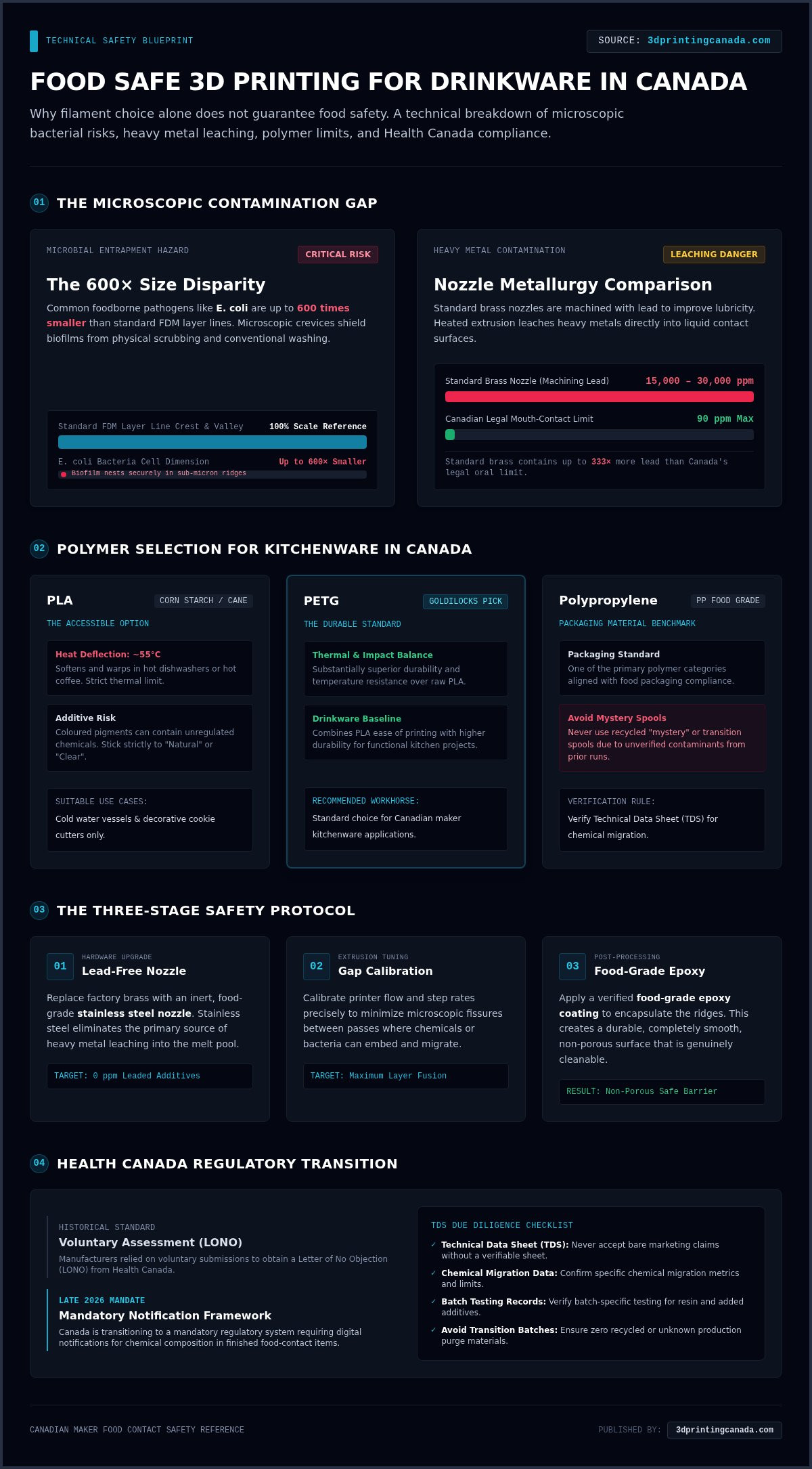
Did you know that common foodborne bacteria like E. coli are up to 600 times smaller than the standard layer lines on your 3D prints? This massive size gap means that even the most thorough scrubbing cannot reach the microscopic crevices where biofilms thrive. It's a frustrating reality for makers who want to move beyond plastic trinkets and start creating functional kitchenware. You've likely felt the anxiety of choosing between conflicting advice or wondered if your standard brass nozzle, which can contain up to 30,000 ppm of lead, is leaching heavy metals into your drinkware.
We understand those safety concerns because we're makers too. This guide simplifies the search for food safe filament for drinkware Canada enthusiasts can use with confidence. You'll learn how to navigate the latest Health Canada food contact frameworks and why your hardware choices matter just as much as your material. We'll show you how to optimize your setup with lead-free stainless steel components and apply the right food-grade epoxy seals to keep your prints hygienic. By the end, you'll have a clear, safe workflow to turn your creative designs into functional reality.
Key Takeaways
- Identify the specific characteristics of PLA and PETG to choose the right material for your next functional kitchen project.
- Navigate the current standards for food safe filament for drinkware Canada to ensure your materials are compliant and safe for mouth contact.
- Understand the microscopic risks of bacterial growth in layer lines and why raw FDM prints require more than just a quick rinse.
- Learn how to properly seal your drinkware using food-grade epoxy coatings to create a smooth, non-porous surface that is easy to clean.
- Implement long-term maintenance and inspection protocols to keep your custom 3D-printed cups in top condition for years to come.
Understanding Food Safety in 3D Printed Drinkware
When you start searching for food safe filament for drinkware Canada, it's easy to assume a "food safe" label on a spool means your finished print is ready for the dinner table. In the world of additive manufacturing, the definition of safety is much more layered. A material might be safe in its raw, pellet form, but the 3D printing process introduces variables that can compromise that status. To print functional kitchenware, you need to think about the entire journey from the extruder to the final sip.
Makers must distinguish between resin certification and final product safety. A filament manufacturer might use FDA-compliant plastic, but that doesn't account for the pigments, flow enhancers, or the heavy metals hiding in your printer's hardware. Safety isn't just a material property; it's a result of your hardware choices and post-processing steps.
FDA vs. Health Canada: What You Need to Know
Most filaments available in the Canadian market highlight US FDA compliance, but our domestic regulations are currently evolving. Historically, manufacturers relied on voluntary assessments to get a Letter of No Objection (LONO) from Health Canada. However, as of late 2026, Canada is moving toward a mandatory framework for food contact materials. This shift requires digital notifications for the chemical composition of finished goods, including 3D-printed cups and utensils.
Always look for a Technical Data Sheet (TDS) before you buy. A reliable manufacturer will provide specific data on chemical migration and batch testing. If a brand only offers vague "food grade" claims without a verifiable TDS, it's best to look elsewhere. Your creative success depends on using materials that meet these rigorous standards.
Chemical Leaching and Toxicity
The biggest hidden risks in 3D printing aren't the plastics themselves, but the additives used for vibrant colours and UV stability. These chemicals can leach into liquids, especially if the drink is acidic or slightly warm. Beyond the filament, your nozzle is a primary source of concern. Standard brass nozzles are often machined with lead to improve lubricity, containing between 15,000 and 30,000 ppm of lead. This is a massive contrast to the Canadian legal limit of 90 ppm for items that come into contact with the mouth.
Switching to a food-grade stainless steel nozzle is a non-negotiable upgrade. Stainless steel is inert and doesn't pose the same heavy-metal leaching risks as brass. It's a simple hardware change that immediately makes your printing environment safer for functional projects. Pair this with a well-calibrated machine to reduce gaps where chemicals or bacteria might hide.
Selecting the Best Food Safe Filaments Available in Canada
Choosing the right spool is your first line of defence when creating functional kitchenware. While there are dozens of exotic materials on the market, most Canadian makers find success focusing on three main types: PLA, PETG, and Polypropylene (PP). Selecting the right 3D printer filament Canada has to offer means looking for transparency from the supplier. You should always avoid recycled "mystery" filaments or "transition" spools for these projects, as they often contain unknown contaminants from previous production runs that aren't safe for oral contact.
When you source food safe filament for drinkware Canada, prioritize manufacturers that align with Health Canada food packaging safety regulations. These guidelines help ensure the polymers and additives used in the filament won't leach harmful substances into your beverages. If you're unsure where to start, you can browse our wide filament selection to find verified options that suit your specific printer setup.
PLA: The Accessible Option
Polylactic Acid (PLA) is often the first choice for beginners because it's easy to print and made from corn starch or sugarcane. While raw PLA is generally safe, it has a major drawback for drinkware: a low heat-deflection temperature. Standard PLA begins to soften around 55°C, meaning a hot cup of coffee or even a run through a warm dishwasher will cause your print to warp and collapse. If you choose PLA, stick to "Natural" or "Clear" varieties. These lack the pigments and dyes that might contain unregulated chemicals. It's a great choice for cold water cups or decorative cookie cutters, but it isn't a long-term solution for durable kitchenware.
PETG: The Durable Standard
PETG is widely considered the "Goldilocks" choice for Canadian makers. It balances the ease of PLA with the durability of more industrial plastics. It's the same material used in most disposable water bottles, offering excellent chemical resistance and a higher temperature tolerance of around 80°C. This makes PETG-printed cups much more resilient during hand-washing with warm water. To get the best results, print slowly to maximize layer adhesion. Stronger bonds between layers mean fewer microscopic gaps where liquids can seep in. It's a reliable, tough material that holds up well to the daily wear and tear of a busy kitchen.
Polypropylene is another contender, often used in Tupperware, but it's notoriously difficult to print due to warping. For most home and professional setups, PETG remains the most practical and safe middle ground.
The Bacteria Trap: Why Filament Alone Is Not Enough
Even if you source the highest quality food safe filament for drinkware Canada provides, the FDM printing process itself introduces a major hurdle: the bacteria trap. Because 3D printers build objects layer by layer, they leave behind microscopic ridges and valleys. While these might look like a cool texture to the naked eye, they're massive canyons for bacteria like E. coli or Salmonella. These pathogens are typically 0.5 to 2.0 microns in size, while your standard layer height is 100 to 300 microns. This means bacterial colonies are 50 to 600 times smaller than the ridges they inhabit, making them nearly impossible to reach with a standard sponge.
Without a proper seal, these prints should be treated as single-use items for food. Sugary drinks or dairy products can seep into these gaps via capillary action. Once inside, they create a foul-smelling biofilm that no amount of soaking can fully remove. To truly understand why smooth surfaces are vital, look at the CFIA guidelines on cleaning and sanitation. These standards exist because porous materials simply cannot be effectively sanitized in a food service environment. If you can't reach the surface, you can't kill the germs.
Porosity and Layer Gaps
Even with a perfectly tuned machine, micro-cracks form between layers. These voids are often the result of slight underextrusion or cooling issues. If your printer isn't pushing out exactly the right amount of plastic, these internal gaps become hidden reservoirs for liquid. This is where professional 3D printer repair services Canada makers rely on become essential. Calibrating your flow rate and ensuring your extruder is in top shape helps minimize these gaps, but it won't eliminate surface porosity entirely. A well-maintained printer is your best tool for reducing the physical space where pathogens can hide.
The Heat Resistance Hurdle
Many makers try to solve the bacteria problem by throwing their prints in the dishwasher. This usually ends in disaster. A standard Canadian dishwasher runs between 55°C and 70°C, which is the exact danger zone for materials like PLA. Your cup will likely come out warped or completely collapsed. While PETG has a higher glass transition temperature of 80°C to 85°C, thin-walled prints are still vulnerable to the intense heat of a drying cycle. Attempting to anneal your prints to increase heat resistance often leads to dimensional shrinkage, ruining the fit of lids or handles. For 3D-printed drinkware, the safest approach is hand-washing with lukewarm water and mild soap.
How to Post-Process Your 3D Printed Drinkware for Safety
Even when you use the best food safe filament for drinkware Canada has to offer, the raw print is not yet ready for your morning juice. As we discussed, the layer lines are a physical reality of FDM printing that must be addressed. To transform a porous plastic object into a functional, hygienic cup, you must apply a food-grade seal. This process creates a glass-like barrier that prevents liquids from ever reaching those microscopic gaps. It's the most critical step in moving from a decorative prototype to a safe, usable kitchen tool.
The gold standard for this is a two-part food-grade epoxy resin. You need to ensure the resin you choose is certified under standards like FDA 21 CFR 175.300, which confirms it's safe for direct food contact once fully cured. In our Canadian climate, indoor curing is usually best to maintain a stable temperature, but you must allow for a full 72-hour cure period at room temperature before the surface becomes truly inert and non-leaching.
Step-by-Step: Sealing Your Cup
Start by preparing the surface. Raw prints are often too ridged for epoxy to flow perfectly. Sand your print using a progression of wet-and-dry sandpaper, starting at 120 grit and moving up to 400 or 600 grit. This levels the "peaks" of your layer lines and gives the resin a better surface to bond with. Once the print is smooth and dust-free, mix your epoxy precisely according to the manufacturer's instructions. Inaccurate mixing is a common mistake that leads to "tacky" spots that never fully cure, which can be a safety hazard.
Apply the resin in thin, even coats. To avoid drips and pooling at the bottom of your cup, many makers use a simple rotating jig, similar to a cup turner used in glitter tumbler crafting. This constant motion ensures the epoxy levels out perfectly across the entire surface. If you see tiny air bubbles, a quick pass with a heat gun or torch will pop them, leaving a crystal-clear finish.
Hardware Upgrades for Better Results
Your post-processing success actually starts on the build plate. Using high-quality Bambu Lab accessories Canada, such as a smooth PEI sheet, ensures the bottom of your cup is perfectly flat and free of texture that might trap bacteria. Additionally, ensuring your fast 3D printer Canada is properly tuned is vital. High-speed printing can sometimes lead to "stringing" or "blobs" if the retraction settings aren't perfect. These small defects create more work during the sanding phase and can lead to thin spots in your epoxy seal.
To get the cleanest possible extrusion before you even start sanding, consider upgrading to a 0.4mm stainless steel nozzle. It provides a more consistent flow and eliminates the lead contamination risks associated with standard brass. If you're ready to optimize your setup for food-safe projects, you can find the right parts and accessories in our shop to ensure your hardware is up to the task.
Maintenance and Best Practices for Your 3D Printed Kitchenware
Once you've successfully printed and sealed your project, your focus shifts to long-term care. Even the best food safe filament for drinkware Canada makers use requires a specific cleaning protocol to remain hygienic. You should always hand-wash your 3D-printed items using lukewarm water and a mild anti-bacterial soap. Avoid abrasive scrubbing pads or stiff brushes; these can create microscopic scratches in your epoxy seal, effectively reopening the door for the bacteria colonies we worked so hard to block.
It's also vital to set boundaries on what your drinkware handles. We strongly recommend avoiding raw meat contact or dairy products. While a properly applied epoxy seal is non-porous, the risk of a hidden pinhole or a microscopic crack is always present. Dairy and meat juices are prime environments for rapid pathogen growth, and the stakes are simply too high for a home-printed item. Stick to water, sodas, or iced tea to keep things safe and simple.
Regular inspection is your best defence against contamination. Before every use, check the interior and rim for any signs of wear. If you notice the plastic is starting to delaminate or if the epoxy has developed deep gouges, it's time to retire the item. A compromised seal means the "bacteria trap" we discussed earlier is no longer contained. In these cases, it's better to repurpose the cup as a desk organizer or a planter rather than risking your health.
Longevity of Food-Safe Coatings
Food-grade epoxy coatings are durable, but they aren't permanent. Over time, regular use and exposure to acidic liquids like orange juice or lemonade can begin to dull the finish. You'll need to monitor the surface quality closely. If you realize the surface has lost its glassy smooth texture or looks cloudy, it's time to thoroughly sand and re-coat the piece. A well-applied seal typically lasts for several months of light use, but your eyes are the best judge of safety. Never try to "push" the lifespan of a coating that looks damaged.
Final Checklist for Your First Cup
Creating safe, functional kitchenware is a rewarding challenge that combines technical skill with a commitment to safety. To ensure your project is a success, follow our "Safe Print" protocol:
- Use a verified food safe filament for drinkware Canada sourced from a reputable supplier.
- Swap to a lead-free stainless steel nozzle before you start your print.
- Calibrate your printer to minimize layer gaps and internal voids.
- Apply a certified food-safe epoxy resin to seal the surface completely.
- Stick to cold or room-temperature beverages only; never use a dishwasher.
We love seeing what the Canadian making community creates. If you've designed a unique, safe piece of drinkware, share your results with fellow hobbyists to help others learn the ropes. When you're ready to start your next kitchen project, you can find all the 3D printing supplies Canada enthusiasts need right here in our shop. Happy printing, and stay safe!
Bring Your Custom Kitchenware to Life Safely
You now have the roadmap to move beyond simple prototypes and start creating functional, safe drinkware. Remember that selecting the right food safe filament for drinkware Canada is only the first step in a successful project. By combining high-quality PETG or PLA with a lead-free stainless steel nozzle and a certified epoxy seal, you're effectively bridging the gap between a raw print and a hygienic household item. Stick to hand-washing and regular inspections to keep your designs in top shape for the long term.
We're here to support every layer of your creative process. Whether you need Bambu Lab accessories to perfect your first layer or expert repair services to eliminate those pesky gaps, our team is ready to help. We provide Canada-wide shipping on all filaments and parts, backed by the expert technical support you need to print with confidence. Shop High-Quality Food-Safe Filaments at 3D Printing Canada and start your next kitchen project today. We can't wait to see what you build.
Frequently Asked Questions
Is PLA filament food safe for drinking cups?
Raw PLA resin is often FDA-compliant, but the printed part is not inherently safe. Pigments and the printing process itself introduce contaminants that aren't present in the virgin material. Furthermore, the porous surface of a 3D print traps bacteria in microscopic valleys. To use PLA safely, you must choose a natural variety without dyes and apply a food-grade sealant to create a non-porous barrier.
Can I put 3D printed drinkware in the dishwasher?
No, you should never put 3D printed items in a dishwasher. The high heat, which often reaches 70°C, exceeds the glass transition temperature of materials like PLA and PETG. This causes the cup to warp, melt, or lose its structural integrity. Additionally, harsh detergents can degrade the food-grade epoxy seal. Always hand-wash your custom drinkware with lukewarm water and mild soap to keep it safe.
Which epoxy resin is food safe for 3D prints in Canada?
You should look for epoxy resins specifically certified under standards like FDA 21 CFR 175.300. In Canada, certain brands are popular because they're formulated to be non-toxic and non-leaching when fully cured for 72 hours. These resins create a glassy barrier that solves the bacteria trap problem. Always verify the Technical Data Sheet to ensure the product meets food contact safety standards before applying it to your project.
Do I need a special nozzle to print food-safe items?
Yes, switching to a 304 or 316 stainless steel nozzle is a mandatory safety upgrade. Standard brass nozzles contain lead to help with the machining process, and this lead can leach into your prints. Since the Canadian legal limit for lead in mouth-contact items is only 90 ppm, the lead found in brass is far too high. Stainless steel is inert and keeps your extrusion path clean during the print.
How do I clean a 3D printed cup without damaging the seal?
Clean your 3D printed cups using lukewarm water and a mild anti-bacterial dish soap. Use a soft microfiber cloth or a gentle sponge rather than abrasive scrubbers or steel wool. Heavy scrubbing can create microscopic scratches in the epoxy coating, which provides a new place for bacteria to hide. If you notice any deep scratches or cracks in the seal, it's time to retire the cup or re-coat it.
What are the risks of using "food safe" filament without a coating?
The primary risk is the bacteria trap created by microscopic layer lines. Even when you buy food safe filament for drinkware Canada, the FDM process leaves ridges that are hundreds of times larger than common pathogens. These gaps collect moisture and nutrients, leading to biofilm growth that cannot be washed away. Without a coating, you also risk heavy metal contamination from the nozzle and unregulated chemical leaching from filament dyes.
Are there any filaments that are naturally dishwasher safe?
While some high-temperature materials like Polypropylene have higher heat resistance, they're still prone to warping in the extreme heat of a dishwasher drying cycle. More importantly, no raw filament solves the porosity issue. Even if the material survives the heat, the layer lines will still trap bacteria. For these reasons, hand-washing remains the only recommended cleaning method for any FDM-printed kitchenware, regardless of the material used.
Can I use 3D printed cups for hot coffee or tea?
It's best to avoid using 3D printed cups for hot beverages. Most food-grade epoxy coatings begin to soften or lose their chemical stability at temperatures above 50°C. Since coffee and tea are served much hotter, the heat could cause the seal to degrade or leach chemicals into your drink. Stick to cold or room-temperature beverages like water or iced tea to ensure your custom drinkware remains safe for daily use.