
What if the groundbreaking 3D printer you just unboxed today is nothing more than an expensive paperweight by next summer? It's a valid worry for any maker or business owner searching for new 3D printers Canada has to offer in 2026. You've likely felt the frustration of ordering a high-tech machine only to face surprise import duties, or worse, finding yourself without a local point of contact when a critical hardware component fails. You want a reliable tool that works right out of the box, not a hobbyist project that requires constant troubleshooting and weeks of waiting for international parts.
We believe your focus should stay on creating, not fixing. This guide helps you cut through the marketing noise to find the most innovative machines that actually deliver on their promises. You'll discover which new features, like AI-powered failure detection and multi-material capabilities, are essential for your workflow and which are just fluff. We'll also show you how to organize your workshop with machines that have a strong Canadian support ecosystem, ensuring you have access to local repair services and parts right here at home.
Key Takeaways
- Learn why 500mm/s print speed is the new baseline for 2026 and how the latest generation of machines has achieved true plug-and-play reliability.
- Discover how to select new 3D printers Canada based on your specific workshop needs, from high-resolution resin models to high-speed FDM production.
- Avoid the headache of international shipping by choosing a local partner that offers dedicated hardware support and expert repair services right here at home.
- Identify the essential AI features and hardware upgrades that protect your investment from becoming obsolete in the fast-moving 2026 market.
- Compare the best "pro-sumer" models for entrepreneurs to ensure your equipment delivers a low cost-per-print without sacrificing quality or uptime.
The 2026 3D Printing Landscape: What Is New in Canada?
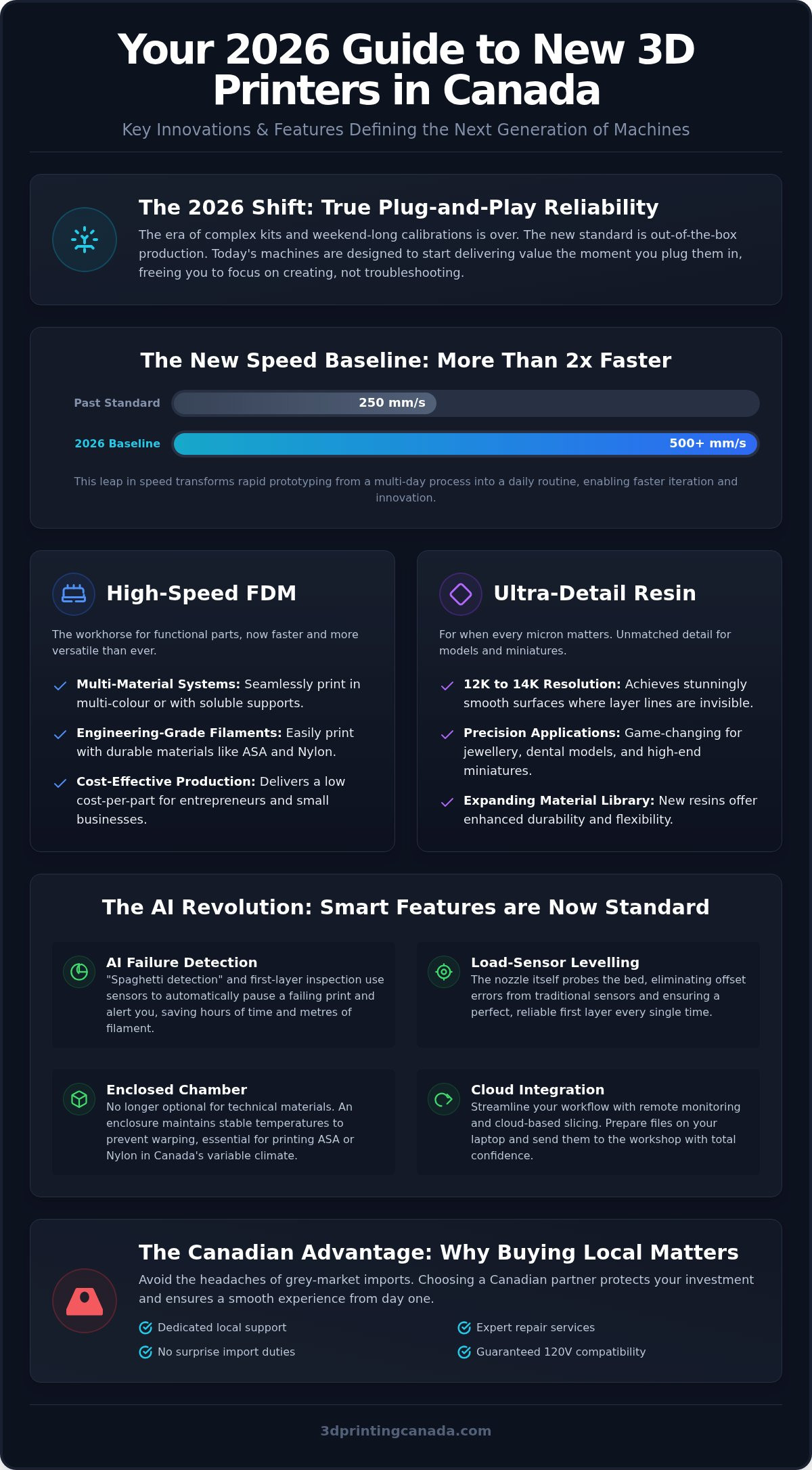
The year 2026 marks a massive shift in how we approach 3D printing technology. Gone are the days when buying a machine meant spending your first weekend assembling a complex kit or calibrating temperamental rails. Today, the focus for anyone looking at new 3D printers Canada is on out-of-the-box production. We've reached a turning point where plug-and-play reliability is the standard, not the exception. Whether you're a hobbyist or running a small business, you expect a machine that starts earning its keep the moment you plug it in.
Source your equipment from a domestic retailer to ensure your machine is built for Canadian electrical standards. You won't need to hunt for adapters or worry about 120V compatibility issues that often plague international grey-market imports. Buying locally means your hardware is ready for your workshop's power grid from day one.
FDM vs. Resin: Which New Tech Wins?
The choice between FDM and resin has never been tougher because both have seen incredible leaps. High-speed FDM printers now regularly hit 500mm/s as a baseline, making rapid prototyping faster than ever. We're seeing a huge shift toward multi-material systems, like the popular AMS units, which allow for complex, multi-colour prints without manual filament swaps. If you're browsing new 3D printers Canada for functional parts, these multi-material FDM systems are the current centre of gravity.
On the other hand, resin technology has pushed into 12K and even 14K resolutions. This level of detail makes layer lines virtually invisible, which is a game-changer for Canadian makers focused on jewellery, dental models, or high-end miniatures. Material versatility has expanded too. You can now easily print with engineering-grade filaments that were once reserved for industrial machines, right from your desktop.
The Rise of Smart Features and AI
Reliability in 2026 is driven by intelligence. Most new machines now include AI-driven first-layer inspection. This feature uses sensors to ensure your print has a solid foundation before it continues, saving you hours of wasted filament. We also see "spaghetti detection" as a standard safety net; if a print fails and starts creating a plastic mess, the machine pauses and alerts you via your phone.
Speed is the first thing you'll notice when comparing new 3D printers Canada offers this year. While 250mm/s was impressive a few seasons ago, 500mm/s is now the baseline for 2026 machines. This jump isn't just about finishing prints faster; it's about making iteration part of your daily routine. To understand the mechanics behind these speeds, it helps to look at how 3D printers work at a fundamental level. Beyond speed, build volume remains a critical trade-off. You need enough room for those "Canadian-scale" projects, like full-sized automotive parts or large architectural models, without sacrificing your entire desk space.
Traditional auto-levelling probes are also being phased out in favour of load-sensor technology. These sensors use the nozzle itself to touch the bed, eliminating the offset errors that used to ruin the first layer. If you plan on printing technical materials like ASA or Nylon, a closed chamber is no longer optional. Enclosures maintain the consistent ambient temperature required to prevent warping, which is especially important during our cold Canadian winters. We recommend checking out a variety of 3D printers and supplies to find a setup that fits your environment.
Multi-Material Capabilities
The biggest trend in 2026 is the seamless transition between filaments. Modern multi-filament systems allow you to mix colours or use dedicated support materials that break away cleanly. If you're looking to push these boundaries, checking out Bambu Lab accessories Canada will show you the latest AMS components designed to make these transitions faster and more reliable. New models have also introduced significant waste-reduction technologies, cutting down on the filament waste that used to be a major drawback of multi-colour printing.
Nozzle and Extruder Innovation
Maintenance has become much simpler with the move toward quick-swap hotends. You can now change a nozzle in seconds without tools, making it easy to switch between a fine 0.2mm for detail and a wide 0.8mm for speed. Hardened steel nozzles are now the standard for new releases, allowing you to use abrasive filaments like carbon fibre or wood-fill without wearing down your hardware. Direct-drive extruders have also evolved. They now handle ultra-flexible TPU with the same precision they bring to rigid PLA. This evolution ensures your machine stays versatile as your creative needs grow.
Top Picks: Standout Models in the 2026 Collection
Choosing the right machine requires looking beyond just the spec sheet. We have carefully vetted our Latest Products collection to ensure every machine meets the demands of the Canadian maker community. This focus on industrial-grade reliability at a desktop scale aligns with the National Research Council's strategic roadmap, which emphasizes the growth of additive manufacturing across the country. Whether you need a workhorse for a small business or a high-precision tool for intricate designs, the 2026 lineup offers new 3D printers Canada can rely on for consistent results.
For those focused on fine detail, specialized resin printers have reached a new peak. These machines are now the standard for jewellery designers and dental applications, offering 14K resolution that makes layer lines a thing of the past. If your work requires microscopic precision, these resin models provide the accuracy needed for professional-grade output right from your workbench.
The Performance Leader: High-Speed FDM
The current flagship "Pro-sumer" models from industry leaders like Bambu Lab and Creality have redefined what we expect from FDM technology. These machines are built for high-speed production, cutting down print times by more than half compared to older generations. They follow the latest fast 3D printer Canada trends by integrating active vibration compensation and high-flow hotends as standard features.
- Speed: Baseline of 500mm/s with acceleration up to 20,000mm/s².
- Build Plate: 256mm x 256mm x 256mm flexible PEI surfaces for easy part removal.
- AI Features: Real-time first-layer scanning and automatic filament tension adjustment.
The Value King: Best New Printer Under $500
You don't need to spend thousands to get a machine that works out of the box. The best value new 3D printers Canada offers in 2026 bring "pro" features like full-colour touchscreens and dual-gear extruders to a hobbyist price point. These machines arrive almost entirely pre-assembled, allowing you to start your first print in under twenty minutes. They provide excellent out-of-the-box quality that rivals much more expensive units from just a few years ago. To get the best results, we suggest bundling these machines with high-quality PLA or PETG filaments to ensure smooth extrusion and vibrant colours from your very first layer.
Choosing Your Printer Based on Canadian Use Cases
Not every machine is the right fit for every desk. Identifying your primary goal is the first step when browsing new 3D printers Canada has available in 2026. For the hobbyist, the focus is often on "fun" features and ease of use. You want a machine that offers a massive community library and a built-in camera for sharing time-lapses on social media. It's about the joy of creating without the technical headache of manual calibration.
Organizing multiple printers for small-batch manufacturing requires a shift in mindset. You need robust fleet management software that lets you monitor every machine from a single dashboard. This allows you to queue jobs across your entire "farm" without running from machine to machine. Sourcing your materials from a consistent Canadian hub is the secret sauce here. It ensures your filament colours and quality remain identical across every batch, which is critical for maintaining professional standards. Shop our full range of performance filaments and printers to start building your professional setup today.
Integrating 3D Scanning into Your Workflow
Pairing your new printer with a 3D scanner Canada opens the door to rapid reverse engineering. This workflow allows you to scan a physical part, modify the digital file, and print a replacement or improvement in hours. Desktop scanners are ideal for small, intricate mechanical components, while handheld units give you the freedom to capture larger objects like automotive panels or custom-fit ergonomic grips. The software bridge between scanning and printing has become much more intuitive in 2026, often allowing you to clean up a scan and send it to the slicer with just a few clicks.
The 3D Printing Canada Advantage: Support and Repairs
Buying new 3D printers Canada enthusiasts choose often comes down to more than just the price tag on the screen. It's about what happens six months later when a fan stops spinning or a sensor loses calibration. When you buy from a domestic partner, you aren't just getting a box; you're gaining a support system. We stock a deep inventory of spare parts and upgrades for every model we carry, ensuring your machine stays in peak condition long after the initial unboxing. We believe that your success as a maker depends on having a reliable partner who understands the hardware inside and out.
Professional Maintenance and Repairs
Hardware snags are part of the journey, but they shouldn't end your project. If your new machine encounters a technical hurdle, our 3D printer repair services Canada team is ready to step in. Our technicians live and breathe this technology. They understand the nuances of Canadian power standards and how local environmental factors, like our variable indoor humidity, affect your hardware. Regular maintenance isn't just about fixing what's broken. It's about proactive care that can double the lifespan of high-speed machines. A quick professional tune-up or a belt tensioning can prevent a small vibration from becoming a major failure, keeping your workshop running smoothly.
Fast Shipping and No Hidden Duties
Ordering internationally often leads to "sticker shock" when the delivery truck arrives. Between brokerage fees, surprise duties, and currency exchange, that "deal" quickly disappears. By choosing a local shop, you avoid these hidden costs entirely. Our national shipping network moves new 3D printers Canada wide from a central hub, getting your gear to you safely and quickly. Dealing with a local warranty is also significantly easier. Instead of shipping a heavy machine across an ocean for a claim, you have a direct line to a Canadian team that speaks your language and understands your needs. We handle the logistics so you can focus on your next big print.
We want you to feel empowered every time you hit "print". When you browse our latest products, you do so with the confidence that we've got your back. From the first layer to the thousandth hour of operation, we provide the tools, the parts, and the human expertise required to make your creative vision a reality. You're part of a community here, and we're invested in your success.
Build Your Future with 2026 Technology
The 2026 landscape has proven that high-speed FDM and high-resolution resin printing are no longer just for the experts. By choosing new 3D printers Canada offers today, you're investing in a future where AI-driven reliability and plug-and-play ease come standard. You don't have to worry about the technical hurdles of the past when you have a local mentor in your corner. We've seen how 500mm/s speeds and smart sensors have transformed workshops from coast to coast.
We take pride in being an authorized retailer for top brands like Bambu Lab and Creality. Your success is our priority. Our national Canadian shipping ensures your gear arrives quickly without hidden duties, while our expert technical repair services provide the long-term security your investment deserves. Whether you're a hobbyist starting your first project or an entrepreneur scaling production, we're here to support every layer of your growth.
Shop the Latest 2026 3D Printers and Accessories
Take the next step in your creative journey with a partner you can trust. We're excited to help you bring your most ambitious designs to life.
Frequently Asked Questions
What is the best new 3D printer for a beginner in Canada for 2026?
The best beginner printer for 2026 is one that prioritizes a seamless setup, such as the Bambu Lab P1S. These new 3D printers Canada makers love are designed for users who want to spend their time creating rather than tinkering with hardware. They offer robust auto-levelling and integrated cameras right out of the box. You'll find these models are incredibly forgiving for those just starting their journey into the world of 3D printing.
Do new 3D printers require a lot of assembly?
Modern machines in 2026 require very little assembly compared to the kits of the past. Most new models arrive ninety percent pre-assembled; you'll typically only need to tighten a few bolts and plug in a couple of cables to get started. Manufacturers have moved toward a plug-and-play standard that allows you to go from unboxing to your first successful print in under thirty minutes without any specialized tools.
Can I use any brand of filament with my new printer?
You can certainly use different brands of filament, but it is important to match the material to your printer's capabilities. With high-speed 2026 machines, we recommend using filaments specifically optimized for 500mm/s flow rates to ensure consistent quality. While 1.75mm remains the industry standard, always check that the material is compatible with your nozzle type, especially if you are using abrasive filaments like carbon fibre or wood-fill.
Is it better to buy a 3D printer from a Canadian shop or directly from the manufacturer?
Buying new 3D printers Canada enthusiasts recommend from a local shop is almost always the better choice. You'll avoid the massive headache of surprise import duties and brokerage fees that come with international shipping. More importantly, you gain a local point of contact for technical support and warranty claims. Manufacturers often require you to ship machines back overseas for repairs, which is expensive and takes weeks to resolve.
What are the most important AI features in 2026 3D printers?
The most critical AI features in 2026 are LIDAR-based first-layer inspection and camera-driven spaghetti detection. These systems work together to monitor your print in real-time, automatically pausing the machine if it detects a failure or a bed-levelling issue. This level of automation prevents filament waste and protects your hardware from damage. It's a massive leap forward for reliability, allowing you to run long prints overnight with much more confidence.
How do I get my 3D printer repaired if it breaks down in Canada?
If your hardware encounters a problem, you can access our professional 3D printer repair services from anywhere in the country. Our in-house technical team specializes in troubleshooting complex hardware failures and performing routine maintenance to keep your machine running at peak performance. We handle everything from nozzle clogs to motherboard replacements. Simply reach out to our support team to organize a service request and keep your creative projects on track.
Are 3D scanners compatible with all new 3D printers?
3D scanners are compatible with virtually all new printers because they generate standard digital files like STL or OBJ. These files are the universal language of the 3D printing world; any modern slicing software can process them for your machine. Whether you're using a handheld scanner for large parts or a desktop unit for small details, the digital model can be easily scaled and optimized to fit your specific printer's build volume.
What is the typical shipping time for a new printer within Canada?
We ship all orders from a central Canadian hub to ensure your gear arrives as quickly as possible. Most customers across the country can expect their new printer to arrive within two to five business days. We use reliable national carriers to handle these heavy shipments with care. This localized approach eliminates the long wait times and potential damage often associated with international freight, getting you printing much sooner.