
What if you could bypass the three-week wait for a third-party prototype and print a functional part at your desk for less than the cost of a coffee? For many Canadian entrepreneurs, the dream of rapid local manufacturing is often sidelined by the high costs of outsourcing and the uncertainty of which hardware can actually handle a professional workload. You've likely felt the frustration of waiting on iteration cycles that kill your momentum while watching your development budget disappear into shipping fees and minimum order quantities.
It's time to take control of your production timeline. This guide explores how 3D printing for small business Canada has evolved into a strategic asset that slashes prototyping costs and accelerates your path to market. We'll show you how to choose reliable hardware like enclosed systems for Canada's varied climate, maximize tax incentives like the 55% CCA Class 50 depreciation rate, and maintain your edge with a dependable local partner for repairs and filament. You'll discover how to transition from waiting on a quote to holding a finished part in hours, ensuring your business stays agile in an increasingly competitive landscape.
Key Takeaways
- Learn how to calculate the ROI of in-house manufacturing by comparing initial capital expenditure against the high fees and shipping delays of third-party prototyping services.
- Identify the ideal technology for your specific workflow by comparing FDM for rugged functional parts and Resin for high-detail visual prototypes.
- Discover why 2026 is the strategic tipping point for 3D Printing Canada, providing professional-grade reliability at accessible price points.
- Minimize downtime by sourcing genuine Bambu Lab accessories and utilizing local technical repair services to keep your production line running smoothly.
- Build a resilient supply chain with a consistent inventory of high-performance filaments to slash your product development cycles from weeks to hours.
The Rise of Additive Manufacturing for Small Businesses in Canada
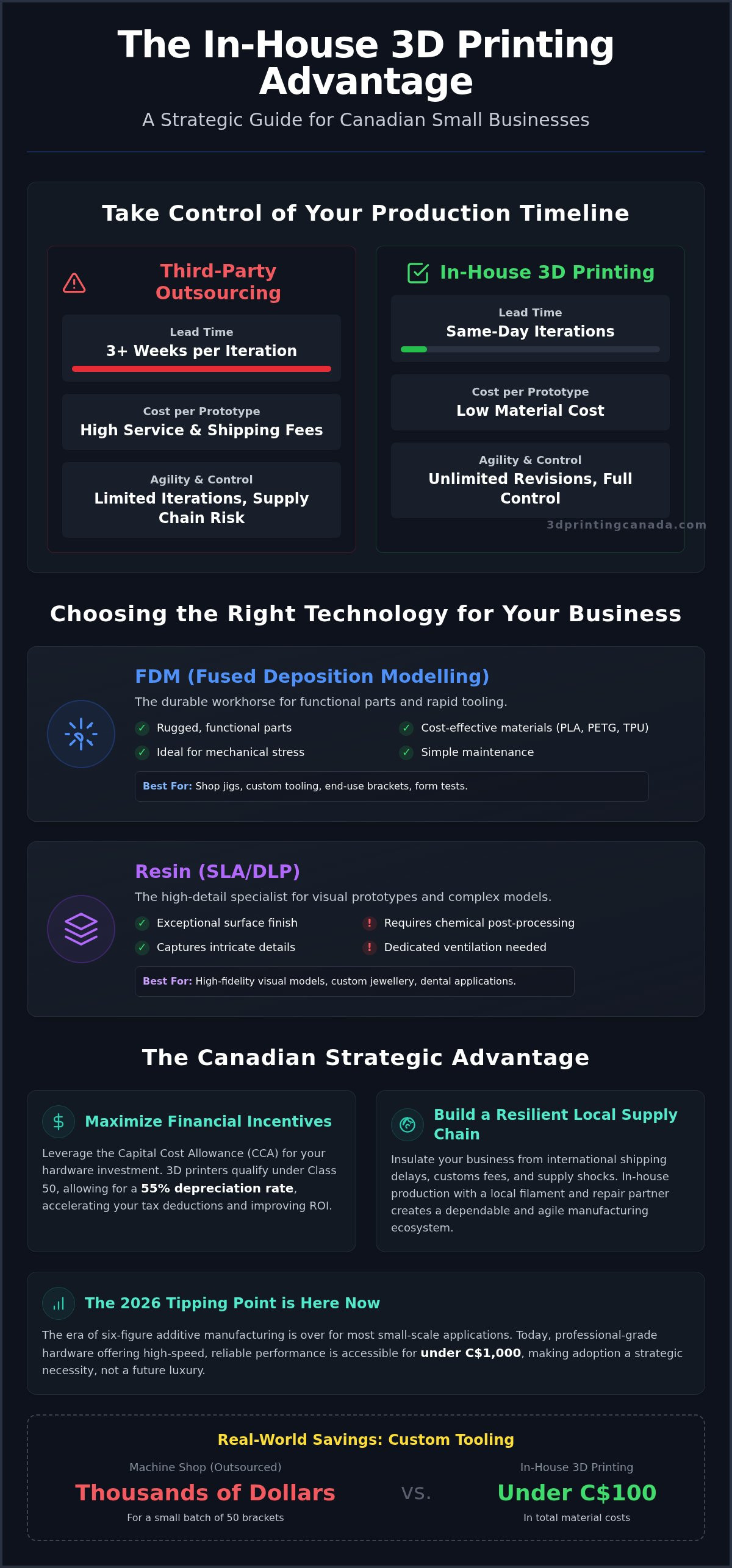
Additive manufacturing is often misunderstood as a novelty for hobbyists. In a professional Canadian context, it's the precise, layer-by-layer construction of components designed to solve specific mechanical or design problems. 2026 represents a strategic tipping point. Hardware that once required a six-figure investment is now accessible for under C$1,000, offering the speed and reliability needed for a professional workload. This shift means 3D printing for small business Canada is no longer about "if" you should adopt it, but how quickly you can integrate it into your workflow.
Industries across the country are already leading this charge. While aerospace and medical sectors use high-end systems for specialized parts, consumer goods manufacturers are using desktop units to disrupt traditional markets. These businesses are leveraging common applications of 3D printing to build everything from custom orthotics to lightweight drone components. By moving production in-house, they gain a massive "Local Advantage." They've effectively insulated themselves from international supply chain shocks, customs delays, and the rising costs of cross-border shipping.
Slashing Lead Times and Prototyping Costs
Traditional prototyping is a slow, expensive drain on resources. When you outsource a design, you're often forced to wait weeks for a single iteration. If that part doesn't fit, you've wasted both time and the "colour of money" on a failed third-party service fee. In-house 3D printing for small business Canada allows for same-day iterations. You can design a part in the morning, print it over lunch, and test it by the afternoon. This rapid cycle lets you realize a faster time-to-market for niche Canadian products, ensuring you beat competitors who are still waiting on a shipping container from overseas.
Custom Tooling and Jigs for the Shop Floor
Efficiency on the shop floor often depends on the tools you use to organize your space. Many businesses find that off-the-shelf solutions don't quite fit their specific needs. 3D printing allows you to manufacture bespoke organizational tools and jigs that help centre your workflow and reduce human error. You can also produce end-use parts for low-volume production runs where traditional injection moulding costs would be prohibitive. For example, a small fabrication shop recently saved thousands of dollars by printing 50 custom cable-management brackets in-house for under C$100 in materials, rather than paying a machine shop for a small-batch run. This level of agility transforms your shop from a standard facility into a high-efficiency production hub.
Choosing the Right Technology: FDM vs. Resin for Professional Use
Selecting the right hardware is the first real hurdle for 3D printing for small business Canada. Your choice between FDM and Resin depends entirely on what you intend to build. FDM (Fused Deposition Modelling) excels at creating functional, durable parts, while Resin (SLA/DLP) is the go-to for high-detail visual prototypes. Beyond the technology, you must consider build volume and material compatibility. A larger build plate allows for bigger batches or single large components, while specialized materials might require specific extruder temperatures or enclosed chambers. Safety is also paramount. Both technologies require proper ventilation, and Resin requires a dedicated space for chemical post-processing. You don't want to realize too late that your workspace isn't equipped for the fumes or cleaning requirements of a specific machine.
FDM Printing: The Workhorse of the Small Business
FDM is the most cost-effective entry point for Canadian shops. It uses spools of thermoplastic filament, making it ideal for everything from shop jigs to end-use brackets. This versatility makes FDM a staple for 3D printing for small business Canada, especially when you need parts that can withstand mechanical stress. The material options are vast. You can use PLA for form tests, PETG for heat resistance, or high-strength TPU for flexible gaskets. Maintenance for high-speed professional machines is straightforward but necessary. Regularly clean your build plate and check for nozzle wear to ensure consistent quality. If you're developing new manufacturing processes, you may even qualify for SR&ED tax incentives for 3D printing to help offset these equipment costs.
Resin Printing: Precision for Intricate Designs
When your work involves client-facing models, dental applications, or jewellery, Resin is the clear winner. It produces surfaces so smooth that layer lines are virtually invisible, which is essential for high-fidelity presentation models. However, you need to account for the post-processing labour. Unlike FDM, resin prints must be washed in isopropyl alcohol and cured under UV light. Managing chemicals and waste is a critical responsibility in a small business environment. You'll need gloves, a well-ventilated area, and a plan for disposing of contaminated wash fluids safely. It's a more involved workflow that requires a dedicated "wet" station, but the professional finish is often worth the extra steps for businesses that prioritize aesthetics and precision.
Choosing between these two depends on your specific goals. If you're leaning toward FDM for its versatility, you can explore the latest Bambu Lab accessories Canada to see how to customize your setup for peak performance.
In-House Printing vs. Outsourcing: Calculating the ROI for Your Shop
Deciding between buying a machine or hiring a service is a classic business dilemma. When evaluating 3D printing for small business Canada, you have to look past the initial sticker price. Initial capital expenditure (CAPEX) for professional hardware, such as a Bambu Lab P2S at C$839 or an A1 at C$379, is a one-time hit. Compare this to ongoing service fees. Outsourced FDM printing in Canada typically costs between C$0.15 and C$0.60 per gram for basic materials. If you print a 200g prototype, you're looking at C$30 to C$120 for a single part. Meanwhile, a full 1kg spool of professional PLA filament costs between C$28 and C$42. You can print five of those same prototypes in-house for the cost of one outsourced order.
Total Cost of Ownership (TCO) must include power, filament, and the labour required for maintenance. However, the hidden costs of outsourcing often represent the biggest drain on your budget. Shipping fees, minimum order requirements, and the "back-and-forth" communication delays can stall a project for weeks. To determine your break-even point, track your monthly print volume. Most Canadian shops realize that if they produce even two functional parts a week, the hardware pays for itself in less than six months. This calculation makes 3D printing for small business Canada a highly predictable investment rather than a recurring expense.
The Agility Factor: Value Beyond the Dollar
ROI isn't just about the ledger; it's about control. Keeping your production in-house protects your intellectual property because you aren't sending proprietary CAD files to a third-party vendor. It also grants you the ability to pivot instantly. If a design fails a fitment test at 10 AM, you can have a corrected version on the build plate by 11 AM. This creates a culture of rapid innovation and trains your team to think in three dimensions. Investing in this technology is a long-term skill investment for your workforce that pays dividends in problem-solving speed.
When Outsourcing Still Makes Sense
Owning a printer doesn't mean you'll never use a service again. Outsourcing is a strategic tool for handling massive production spikes that exceed your in-house capacity. It's also the most practical way to access specialized materials like industrial metal or SLS nylon, which require machines costing tens of thousands of dollars. Finally, if you need a "show-ready" presentation model with a factory-perfect finish for a high-stakes client meeting, a professional service can provide the specialized post-processing that a busy shop floor might not have the time to centre on.
Essential Supplies and Workflow Integration for Canadian Entrepreneurs
Success in additive manufacturing isn't just about the machine on your desk; it's about the ecosystem supporting it. To keep your production line moving, you need to build a reliable inventory of 3D printing supplies Canada. This means more than just having an extra spool of plastic; it involves stocking spare nozzles, build plates, and adhesives to prevent unexpected downtime. For most 3D printing for small business Canada applications, your material choice dictates your success. Use PLA when you need to realize high-detail visual models or fitment tests quickly. Switch to PETG when you require functional parts that need higher heat resistance and durability. Organizing these materials in a humidity-controlled environment is the first step toward building a high-uptime "print farm" that delivers repeatable results every time.
Procurement and Bulk Supply Management
Managing your margins requires a shift from hobbyist buying to professional procurement. Buying filament in bulk is essential to protect your bottom line. When you buy in larger quantities, you don't just save on the cost-per-kilogram; you also ensure material consistency across a production run. Different batches can have slight colour or diameter variances that mess with your print settings. Work with a Canadian partner who speaks procurement and understands the needs of B2B buyers. We provide the documentation and high-volume consumables needed to keep your workshop running without the headache of cross-border customs or unpredictable shipping times.
Integrating 3D Scanning into Your Workflow
Hardware is only half the battle. Many entrepreneurs are now using a 3D scanner Canada to bridge the gap between physical objects and digital designs. This technology is a game-changer for rapid reverse engineering. If you have a legacy part with no original CAD file, you can scan it, refine the mesh, and print a replacement in hours. Scanners also serve a vital role in quality assurance. By comparing a printed part back to the original digital model, you can verify tolerances and ensure your output meets professional standards. This process digitizes your inventory, allowing you to eliminate physical storage needs for old moulds or templates.
Ready to streamline your shop? Browse our full range of high-performance filaments and start building your local supply chain today.
Scaling Your Production with Professional Hardware and Support
Scaling your production capacity is about more than just adding more build plates to your shop floor. As your volume increases, the reliability of your hardware becomes the single most important factor in your success. Establishing a partnership with an authorized reseller is a critical step for 3D printing for small business Canada, as it guarantees access to official warranties and specialized technical support that hobbyist marketplaces simply can't provide. You need to know that if a component fails during a 48-hour print run, you have a local team ready to help you recover.
High-speed machines require specific upkeep to maintain their performance over thousands of print hours. Using genuine Bambu Lab accessories Canada ensures that your nozzles, belts, and extruders are rated for the intense workloads of a professional environment. Don't settle for third-party parts that might compromise your machine's precision or longevity. Keeping your machines in peak condition is the only way to ensure your cost-per-part remains predictable.
Hardware Reliability and Maintenance
Establishing a maintenance checklist is the best way to keep your machines running 24/7. Set aside time for weekly tasks like checking belt tension and cleaning build plates. Monthly, you should inspect your carbon rods and lubricate lead screws to prevent friction-related errors. Even with the best care, hardware failures like clogged extruders or thermistor issues can stop production entirely. This is why professional 3D printer repair services Canada act as a vital business safety net. Having an in-house technical team you can call on means you can minimize downtime and keep your promises to your customers without having to ship machines across borders for service.
Partnering for Success
Building a successful shop means finding a mentor-style partner who understands your specific industry challenges. Whether you're struggling with complex material settings for Nylon or trying to optimize your slicer profiles for speed, having access to technical expertise is invaluable. As you scale from one machine to a full production fleet, your needs will shift from simple hardware advice to high-volume procurement strategies. A partner who understands 3D printing for small business Canada will help you select the right mix of hardware to balance your output and quality. We focus on providing the comprehensive knowledge and human support required to help you realize your creative and commercial goals.
Future-Proof Your Canadian Manufacturing Strategy
The shift toward in-house production isn't just a trend; it's a fundamental change in how Canadian companies compete. By understanding the ROI of hardware ownership and selecting the right technology for your specific workflow, you've already taken the first step toward total production agility. You don't have to wait weeks for prototypes or struggle with high outsourcing fees anymore. Implementing 3D printing for small business Canada allows you to iterate faster, protect your designs, and build a resilient supply chain right on your shop floor.
Success depends on having a dependable partner who understands your operational needs. We're an authorized Canadian reseller for Bambu Lab and Prusa, providing the professional hardware and technical expertise required to keep your fleet running. Our on-site technical repair experts and fast national shipping on over 800 filaments ensure your production never stops. Take control of your development cycle and realize your product goals with confidence.
Browse Professional 3D Printers and Get Expert Business Advice to start your transition today. Your next big innovation is only a print away.
Frequently Asked Questions
Is 3D printing cost-effective for a small business in Canada?
Yes, it's highly cost-effective because it reduces the cost-per-part from dollars to cents. While outsourcing FDM prints in Canada can cost up to C$0.60 per gram, printing in-house with a C$30 spool of filament significantly lowers your overhead. You also save on shipping fees and minimum order quantities. Small businesses can further offset costs by utilizing the 55% CCA Class 50 depreciation rate for computer equipment and 3D printers.
What is the best 3D printer for a Canadian startup in 2026?
The best printer depends on your specific application, but enclosed models like the Bambu Lab P2S are top choices for 2026. These machines provide the temperature stability needed for materials like ABS and ASA, which is vital in Canada's varied indoor climates. For startups on a tighter budget, the Bambu Lab A1 offers professional-grade reliability at a C$379 price point. Both options provide the speed and accuracy required for a professional workload.
How much space do I need to set up a professional 3D printing area?
You can start with as little as a single sturdy workbench, but a professional 3D printing for small business Canada setup requires about 10 to 15 square feet. This space accommodates the printer, a filament storage cabinet, and a small post-processing station. If you choose Resin technology, you'll need additional room for a "wet station" to handle washing and curing. Always ensure your chosen area has adequate ventilation and access to a dedicated power circuit.
Can I use 3D printing for end-use products or just prototypes?
Yes, you can absolutely manufacture end-use products for low-volume production runs. High-performance filaments like PETG or TPU allow you to create durable, functional parts that are ready for the market. This is especially useful for niche products where traditional injection moulding costs are too high. Many Canadian entrepreneurs use their printers to produce custom brackets, enclosures, and specialized tools that are sold directly to customers as finished goods.
What are the main safety requirements for running a 3D printer in an office?
Safety in an office environment centres on ventilation and fire prevention. Ensure your machines use HEPA or active carbon filters to manage ultra-fine particles and volatile organic compounds. You must also adhere to the Canada Consumer Product Safety Act by keeping workstations clear of flammable materials and using personal protective equipment when handling resins. Proper training for your team on the safe operation of hardware is a mandatory step for any professional workspace.
Where can I get professional 3D printer repair in Canada?
You can access professional 3D printer repair services right here through our in-house technical team. We specialize in maintaining hardware for professional users and startups across the country. Having a local partner for repairs eliminates the need to ship expensive machinery across international borders, which avoids customs delays and high shipping costs. Our experts ensure your machines return to the production line with minimal downtime.
Do I need specialized CAD skills to use 3D printing for my business?
You don't need to be a CAD expert to begin, but basic design knowledge helps you get the most out of the technology. Many businesses start by using 3D scanners to digitize existing parts or by hiring designers for custom models. You can also find high-quality, commercially licensed models online for common shop tools. As you scale, learning software like Fusion 360 allows you to iterate on your own proprietary designs in-house.
How do I handle shipping and logistics for 3D printing supplies nationally?
Partnering with a domestic supplier is the most efficient way to manage your 3D printing for small business Canada logistics. We offer fast national shipping on over 800 types of filaments and essential spare parts, ensuring you never run out of stock. Buying locally helps you avoid the unpredictable duties and long lead times associated with international vendors. This allows you to maintain a lean inventory while still meeting your production deadlines.