
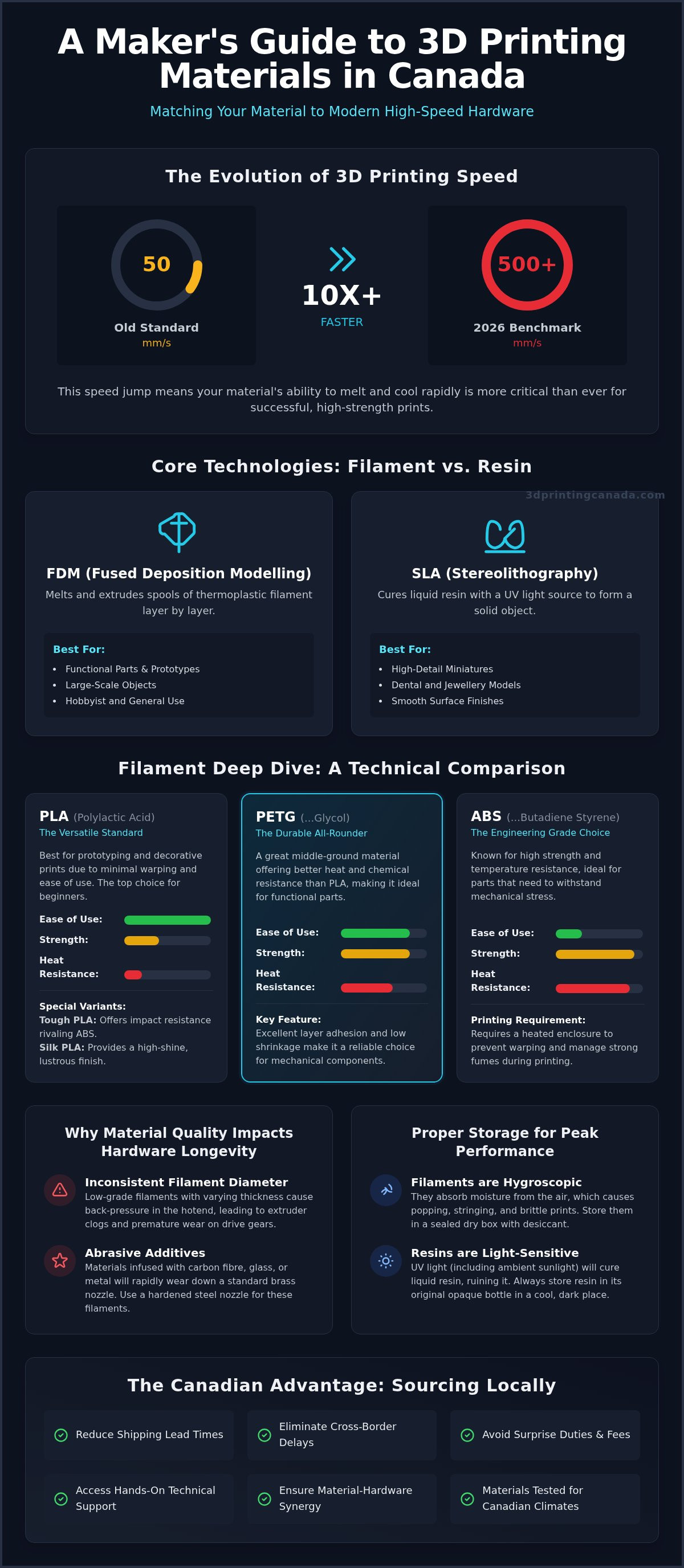
Did you know that the benchmark for a "fast" 3D printer has surged to 500mm/s or higher in 2026? This massive jump from the old 50mm/s standard means your choice of 3D printing materials Canada provides is more critical than ever. If your filament cannot melt and cool fast enough to keep up with your hardware, even the most expensive machine will produce brittle, under-extruded parts.
We know it's frustrating to deal with inconsistent print quality or the sting of high shipping fees on heavy spools. You want successful, high-strength prints without the guesswork of material safety or hardware compatibility. This guide promises to help you select, source, and optimize the best filaments and resins for any Canadian project, from hobbyist PLA to professional engineering resins. We will explore cost-effective bulk sourcing, the latest high-flow filaments, and expert tips for matching your material to your hardware for perfect results every time.
Key Takeaways
- Learn how the Canadian market has evolved from basic PLA to specialized engineering resins to meet modern industrial and hobbyist demands.
- Understand how chemical properties and the unique Canadian climate influence the performance and long-term durability of PLA, PETG, and ABS.
- Discover how to select high-flow 3D printing materials Canada experts recommend for machines operating at speeds exceeding 200mm/s.
- Identify the specific filaments and resins required for high-stress mechanical parts and food-safe applications while following current safety standards.
- Realize the benefits of sourcing from domestic retailers who offer hands-on technical support and accessories specifically for high-speed hardware.
Navigating the 3D Printing Materials Landscape in Canada
Think of your 3D printer as a high-performance engine. It doesn't matter how fast the pistons move if you're using the wrong fuel. In the additive manufacturing world, 3D printing materials Canada provides are the critical foundation for every successful project. We've seen the Canadian market evolve rapidly from basic PLA hobbyist spools to advanced engineering thermoplastics like ASA and Carbon Fibre Nylon. This shift isn't just about variety; it's about matching the chemical properties of your material to the specific demands of your hardware and environment.
Sourcing your supplies within Canada is no longer just a matter of convenience. It's a strategic move to reduce shipping lead times and eliminate the headache of cross-border customs delays. When you buy domestic, you ensure your production schedule stays on track and you avoid the surprise duties that often come with international orders. This local approach also allows for a better understanding of "Material-Hardware Synergy." By selecting materials tested for our climate and common hardware setups, you significantly increase your success rate.
The Core Categories: FDM Filaments vs. SLA Resins
Most Canadian makers operate in two main camps. Fused Deposition Modelling (FDM) relies on the Fused Filament Fabrication process, where thermoplastic filaments like PLA, PETG, and ABS are melted and extruded. PLA remains the go-to for ease of use, while PETG offers better heat resistance for functional parts. On the other side, Stereolithography (SLA) uses liquid resins cured by UV light. These are perfect for high-detail miniatures or dental applications where precision is paramount.
Storage requirements differ greatly between these two. Filaments are often hygroscopic, meaning they soak up moisture from the air, which leads to "popping" and poor surface finish during prints. Resins are sensitive to ambient light and temperature. Keep your filaments in sealed dry boxes and your resins in a cool, dark place to maintain their shelf life and printability.
Why Material Quality Impacts Hardware Longevity
Cheap, low-grade filaments often suffer from inconsistent diameters. If a spool varies even by a few microns, it can cause back-pressure in your hotend. This leads to frustrating extruder clogs and unnecessary wear on your drive gears. Abrasive materials, such as those infused with carbon fibre or glass, will eat through a standard brass nozzle in a matter of hours.
Matching your nozzle to your material is part of that essential hardware synergy. If you've already run into trouble with persistent jams or under-extrusion, you might need expert 3D printer repair services in Canada to get your machine back to factory specs. Using high-quality, verified 3D printing materials Canada retailers stock is the best way to prevent these hardware headaches before they start.
A Technical Deep Dive into Popular Canadian Filaments
When evaluating 3D printing materials Canada retailers offer, you've got to look past the surface. Chemical properties like glass transition temperature and melt flow index dictate how a part handles stress. A comprehensive review of 3D printing materials and technology highlights how polymer chains affect layer adhesion, which is the secret sauce for strong prints. We also prioritize "True Colour" consistency. Nothing ruins a multi-spool project faster than a slight shade shift between batches, so we focus on sourcing filaments with tight pigment tolerances.
PLA: The Versatile Standard for Every Maker
Most makers start with PLA because it's incredibly forgiving. It remains the top choice for prototyping and decorative prints due to its minimal warping. For the best results, keep your bed at 60°C and crank your cooling fans to 100% after the first layer. This prevents drooping on overhangs and ensures sharp details. We've seen a surge in "Tough PLA" across the country. It offers the ease of standard PLA but with impact resistance that rivals ABS, making it a favourite for Canadian makers who don't want to mess with enclosures. Silk PLA variants are also popular for their high-shine finish, though they require slightly slower print speeds to maintain that lustre.
PETG and ABS: Stepping Up to Functional Parts
Stepping up to functional parts usually means choosing between PETG and ABS. PETG is your middle ground. It handles the Canadian summer heat better than PLA without the warping headaches. It's essentially the same plastic used in water bottles, offering great chemical resistance and durability. If you're looking for specialized options, you can browse our full range of filaments to find the perfect match for your project.
Thermal management is the biggest hurdle with ABS. Enclosures and ventilation are non-negotiable for success. ABS releases VOCs that require proper filtration, and it has a high thermal contraction rate. Without a stable, warm environment, your parts will peel right off the bed during long print cycles. You'll need to manage that cooling carefully; too much fan and your layers won't bond, too little and the part loses its shape.
Moisture management is another critical factor, especially with Nylon. This material is incredibly strong but highly hygroscopic. In a humid Canadian summer, Nylon can become unprintable in just a few hours if left out. It literally drinks water from the air. This moisture turns to steam in your nozzle, causing bubbles and weak spots. Always dry your Nylon before use and store it in a dedicated dry box to ensure your 3D printing materials Canada purchases stay in peak condition.
Application-Specific Materials: Safety, Strength, and Speed
Choosing the right 3D printing materials Canada provides often starts with a simple question: what does this part need to do? A decorative figurine requires excellent surface finish, while a bracket for a roof rack needs UV resistance and impact strength. Matching the material to the application saves time and prevents part failure. For high-stress mechanical environments, we look toward specialty additives like carbon fibre or glass beads. These reinforcements increase rigidity and reduce shrinkage, making it easier to print large, dimensionally accurate components that won't warp under load. This focus on precision and specialized application is mirrored in other high-tech sectors, such as the medical field where Jett Medical Canada provides advanced plasma pen devices for dermatology and aesthetics.
Your material choice also dictates your post-processing workflow. If you want a mirror-smooth finish on a car part, ASA or ABS are ideal because they respond well to vapour smoothing. PLA, while easier to print, requires manual sanding and priming if you plan to paint it. Understanding these downstream steps helps you pick a material that fits your entire production cycle, not just the time spent on the print bed.
There's a lot of confusion regarding food safety in the Canadian printing community. It's vital to distinguish between an "FDA-compliant raw material" and a "food-safe 3D printed part." Even if the filament is made from compliant PETG or Polypropylene, the FDM process creates microscopic gaps between layer lines. These ridges are perfect breeding grounds for bacteria and are nearly impossible to sanitize.
As of 2026, Health Canada and the Canadian Food Inspection Agency (CFIA) do not offer specific pre-market certifications for 3D printed products. Instead, all items fall under the Canada Consumer Product Safety Act (CCPSA), which puts the responsibility on the maker to ensure product safety. If you're creating items for food contact, we recommend using materials like PETG or PP and sealing the final print with a food-safe, food-grade epoxy coating. This fills the layer lines and creates a non-porous surface that you can actually clean.
Engineering Blends: Carbon Fibre and ASA
For projects that live outdoors in the harsh Canadian climate, ASA is the undisputed champion. It offers the mechanical strength of ABS but adds incredible UV resistance. While ABS will yellow and become brittle after a summer in the sun, ASA maintains its colour and structural integrity. It's the go-to choice for automotive trim or outdoor sensor housings.
If your project demands maximum stiffness and minimal weight, Carbon Fibre PLA is a game changer. The carbon fibre strands act as a structural skeleton, making the part much more rigid than standard PLA. However, these materials are highly abrasive. To use them successfully, you'll need to upgrade your hardware. A standard brass nozzle will wear out in a single print; you must switch to a hardened steel nozzle to handle the grit of these engineering blends. Investing in the right 3D printing materials Canada retailers stock ensures your machine stays healthy while producing professional-grade results. For components that require even greater industrial strength beyond what polymers can offer, traditional manufacturing leaders like Bowmanville Foundry provide a time-tested alternative with their specialized iron casting services.
The speed of additive manufacturing has reached a breaking point. As we noted earlier, the 2026 benchmark for a fast machine is now 500mm/s. This creates a massive challenge for standard 3D printing materials Canada hobbyists have used for years. Most traditional filaments simply can't melt fast enough to keep up with these high-acceleration toolheads. When your printer moves faster than your material can flow, you end up with under-extrusion, weak layer bonds, and parts that look like Swiss cheese.
High-flow filaments solve this by using chemically engineered polymers with a lower viscosity and faster crystallization rate. This allows the plastic to melt almost instantly in the hotend and solidify just as quickly once it hits the build plate. To get the most out of these materials, you need to calibrate your slicer's "Max Volumetric Speed" setting. Don't just bump up the print speed; ensure your hotend temperature is high enough to maintain a consistent flow. Utilizing the right Bambu Lab accessories in Canada, like high-flow nozzles, is essential for maintaining these blistering speeds without sacrificing part strength.
The Bambu Lab AMS Ecosystem
The Automatic Material System (AMS) has revolutionized how we handle multi-colour and multi-material projects. It allows for seamless transitions between different 3D printing materials Canada makers use for complex supports or aesthetic designs. However, the AMS is picky about spool types. While plastic spools work perfectly, cardboard spools can shed dust that clogs the internal gears or slip on the drive rollers. We recommend using printed spool rings or transferring your filament to plastic refills to keep the system running smoothly. For a deeper look at how these systems fit into the broader market, check out the latest fast 3D printer Canada trends.
Material Storage: Preventing Print Failure Before it Starts
At high speeds, even a tiny amount of moisture in your filament becomes a project-killing defect. Wet filament creates steam in the nozzle, leading to popping sounds and messy stringing. Follow this 4-step process to ensure reliability:
- Identify: Listen for crackling during extrusion or look for a fuzzy surface finish.
- Dry: Use a dedicated filament dehydrator; don't rely on a kitchen oven which can fluctuate in temperature.
- Measure: Keep a hygrometer inside your storage bins to monitor humidity levels.
- Store: Use airtight dry boxes with fresh desiccant, especially during humid Canadian summers.
If you're ready to upgrade your setup for maximum velocity, shop our high-flow filament collection to find materials built for the next generation of speed.
Sourcing 3D Printing Materials: The Professional Advantage
Where you buy your supplies matters just as much as the printer sitting on your desk. While mass marketplaces might tempt you with rock-bottom prices, they often hide risks like aged stock, inconsistent diameters, and zero technical support. When you're in the middle of a 48-hour print, you don't want to find out your "bargain" spool was stored in a damp warehouse for a year. Sourcing 3D printing materials Canada retailers stock ensures you get fresh, vetted inventory that has been tested for our specific climate and hardware standards.
The real differentiator is the human element. At 3D Printing Canada, our technical support team actually prints daily. We don't just read from a script; we provide peer-to-peer advice based on real-world troubleshooting. Whether you're dealing with a complex material failure or need advice on hardware compatibility, having a knowledgeable mentor in your corner turns a frustrating setback into a learning opportunity. This community-oriented approach is what builds long-term success for both hobbyists and professionals.
Procurement and Bulk Sourcing for Canadian Businesses
Managing a supply chain for a print farm or an educational institution requires a focus on consistency. If you're running a production line of fifty parts, you need the first part to look identical to the last. Bulk procurement allows you to secure spools from the same manufacturing batch, eliminating the slight colour shifts or melt-flow variations that can plague smaller, fragmented orders.
- Industrial Spools: Transitioning to 5kg or 10kg spools reduces spool-change downtime and lowers your cost per kilogram.
- Inventory Management: Establish a reliable schedule for high-volume materials like PLA and PETG to avoid production gaps.
- Specialized Requirements: Access custom sourcing for engineering-grade materials that meet specific flame-retardant or high-temp certifications.
Why Expert Support is the Ultimate Upgrade
Think of expert support as the ultimate firmware update for your workflow. Beyond just fixing clogs, a professional partner helps you expand your capabilities. As your projects grow in complexity, you might find yourself moving beyond simple extrusion into advanced territory. For those looking to integrate physical objects into their digital workflow, exploring 3D scanner Canada technology guides can open up new possibilities for reverse engineering and quality control.
We're here to be more than just a shop; we're your long-term partner in creative success. From sourcing 800+ filament varieties to providing the technical repair services that keep your fleet running, our goal is to empower the Canadian community. Don't settle for "mystery meat" filament from a nameless warehouse. Choose the reliability, expertise, and local support that only a dedicated 3D printing specialist can provide.
Elevate Your Additive Manufacturing Potential
Success in 2026 demands more than just a fast machine. It requires a deep understanding of how your choice of 3D printing materials Canada affects every layer of your project. Whether you're optimizing for 500mm/s speeds with high-flow filaments or ensuring outdoor durability with UV-resistant ASA, the synergy between your hardware and your supplies is what separates a failed print from a professional-grade component.
Don't leave your results to chance with unverified marketplaces. As an authorized reseller for top global brands, we provide the expert Canadian technical support and fast national shipping on 800+ varieties that you need to scale your production. Our team of daily makers is here to help you troubleshoot complex material failures and find the perfect match for your hardware. We believe that having a knowledgeable mentor in your corner is the ultimate upgrade for any workshop.
Shop Canada’s Largest Selection of 3D Printing Materials today and start your next project with confidence. Your next great creation is waiting to be printed. Let's make it happen together.
Frequently Asked Questions
What is the best 3D printer filament for beginners in Canada?
PLA (Polylactic Acid) is the best choice for beginners due to its low melting temperature and minimal warping. It doesn't require a heated enclosure, making it compatible with almost any entry-level machine. You can achieve high-quality results with standard slicer settings, allowing you to focus on learning the basics of 3D printing. It's also available in a massive variety of colours, which makes your first creative projects much more exciting and rewarding.
Where can I buy 3D printer filament in bulk in Canada?
You can source bulk 3D printing materials Canada through specialized retailers that offer 5kg and 10kg spools. Purchasing in larger quantities is ideal for print farms or educational institutions looking to reduce the cost per kilogram and minimize spool changes during long production runs. Buying in bulk from a domestic supplier also ensures better batch consistency and eliminates the risk of international shipping delays or unexpected customs duties at the border.
Is PLA or PETG better for functional outdoor parts?
PETG is significantly better for functional outdoor parts because it offers superior UV resistance and a higher glass transition temperature than PLA. While PLA will warp and become brittle when exposed to the Canadian summer sun, PETG maintains its structural integrity and impact resistance. For even harsher environments, consider ASA, which is chemically engineered specifically for long-term weather resistance and colour stability in outdoor applications where standard plastics often fail.
How do I know if my 3D printer filament has absorbed moisture?
You'll know your filament is "wet" if you hear audible popping or crackling sounds coming from the nozzle during a print. This happens as absorbed water turns into steam. Other signs include excessive stringing, a fuzzy or inconsistent surface finish, and poor layer adhesion. If you notice these issues, especially with hygroscopic materials like Nylon or PETG, use a dedicated filament dryer to restore the material to its original, reliable printing state.
Can I use any brand of filament in my Bambu Lab printer?
Yes, you can use any brand of filament in a Bambu Lab printer, though you must consider the spool type if you're using the Automatic Material System (AMS). The AMS works best with plastic spools that have a specific diameter and width. Cardboard spools can sometimes slip on the rollers or shed dust into the internal gears. We recommend using printed spool adapters or plastic refills to ensure reliable feeding and multi-colour transitions.
Are 3D printing resins more toxic than filaments?
3D printing resins generally require more rigorous safety precautions than common filaments like PLA. Liquid resins are skin irritants and sensitizers, requiring the use of nitrile gloves and eye protection. They also release Volatile Organic Compounds (VOCs) that necessitate proper ventilation or air filtration. While materials like ABS also release fumes, the handling of liquid chemicals makes resin printing a more technically demanding process regarding workplace safety and hazardous waste disposal.
What is the standard filament diameter used in Canada?
The standard filament diameter used in Canada is 1.75mm, which is compatible with the vast majority of consumer and professional FDM printers on the market. While some legacy machines or specific brands like older Ultimaker models use 2.85mm, these are becoming less common. Always verify your printer's extruder and hotend specifications before purchasing 3D printing materials Canada to ensure you're getting the correct diameter for your specific hardware setup and avoiding potential clogs.
How much does 3D printer filament typically cost in Canada?
Filament pricing varies based on the material's chemical composition and the spool size. Standard options like PLA and PETG are generally the most affordable, while specialized engineering materials or high-performance resins sit at a higher price point. Purchasing in bulk, such as 5kg or 10kg spools, is a practical way to reduce your cost per kilogram. It's always best to check current listings for specific varieties to find a balance between performance and your project budget.