
In a fast-moving industry where "new" usually implies "better," the bambu lab a1 has achieved something rare. It has become a reliable legacy machine while remaining the most practical choice for your workbench. It stays the gold standard for Canadian makers who want professional results without the tedious ritual of manual bed levelling. You've likely felt that familiar sting of frustration when a print fails because of a complex hardware tweak you didn't have time to master.
We agree that 3D printing should focus on the joy of creation, not the headache of constant maintenance or the fear of a broken part. This 2026 guide shows you why this machine is still the ultimate "bed-slinger" for your creative space. You'll discover how to achieve reliable multi-colour prints and learn why having a local Canadian source for parts and repairs changes the game for your productivity.
We're going to break down the latest firmware enhancements and the seamless AMS lite integration. We also explore how our in-house technical support ensures you spend more time printing and less time worrying about expensive overseas shipping delays or customs hurdles.
Key Takeaways
- Master the automation features of the bambu lab a1, including full-auto calibration and vibration compensation that eliminate traditional technical headaches.
- Explore how the AMS lite system makes multi-colour printing accessible for any skill level without requiring complex manual adjustments or deep technical expertise.
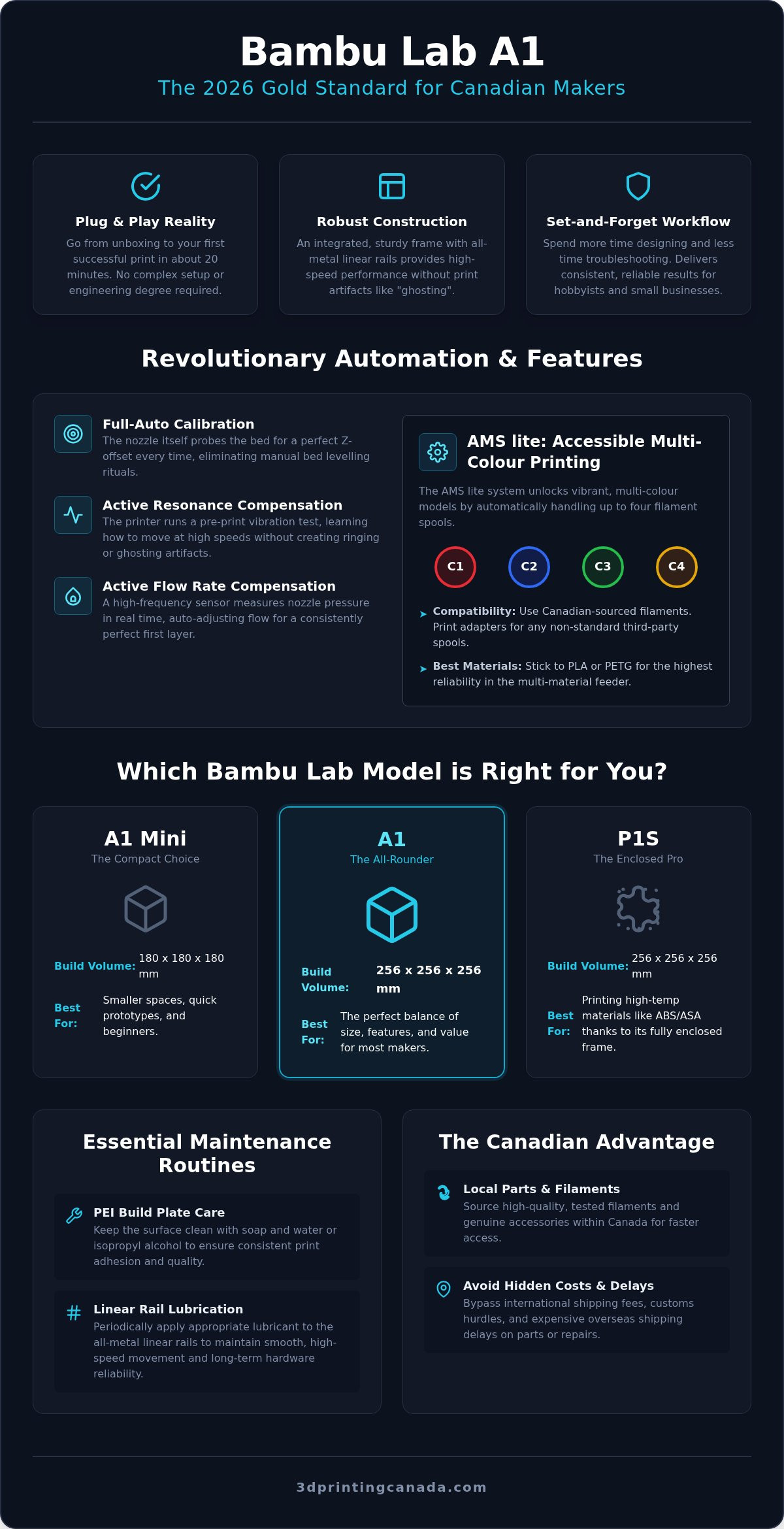
- Identify the right model for your workshop by comparing the 256mm³ build volume of the A1 against the compact A1 Mini and the enclosed P1S.
- Learn simple maintenance routines for your PEI build plate and linear rails to ensure consistent print quality and long-term hardware reliability.
- Save time and avoid hidden costs by sourcing accessories and filaments within Canada to bypass international shipping fees and customs delays.
What Makes the Bambu Lab A1 a Game-Changer in 2026?
The 3D printing world used to be divided between expensive, complex machines and cheap, high-maintenance hobbyist printers. The bambu lab a1 shattered that divide. While it uses the traditional "bed-slinger" design, it operates with the intelligence of a high-end CoreXY system. It represents a "Plug and Play" philosophy that actually works. You don't need a degree in mechanical engineering to get started. You just need a creative idea and a few minutes to unbox.
This machine is built for longevity. It moves away from the flimsy components of the past, offering a robust frame that handles the rigours of daily production. For many Canadian makers, it provides a "set-and-forget" workflow. This means you can spend your time designing instead of troubleshooting hardware failures or chasing technical ghosts.
The Evolution of the Bed-Slinger Design
Engineers at Bambu Lab reimagined what a moving bed could do. They stabilized the Y-axis using all-metal linear rails and a rigid frame, allowing for high-speed performance without the "ghosting" artifacts common in older models. A standout feature is the Active Flow Rate Compensation. This system uses a high-frequency sensor to measure nozzle pressure in real time. It adjusts the flow automatically, ensuring your first layer is consistently perfect.
- Rigid Construction: Unlike traditional aluminium extrusion frames, the A1 uses a more integrated, sturdy build.
- Precision Sensors: Automated checks replace the need for manual calibration.
- Speed: It maintains quality even at velocities that would cause other bed-slingers to stumble.
Empowering Canadian Makers and Small Businesses
For local entrepreneurs, time is the most valuable resource. The bambu lab a1 is the ideal entry point because it respects your schedule. You can go from unboxing to your first successful print in about 20 minutes. This low learning curve allows small businesses to scale up quickly. Whether you're making custom cookie cutters or functional prototypes, you need hardware that's reliable. In a professional environment, "good enough" isn't enough. You need consistent results. This printer delivers that stability, backed by a community that values performance over constant tinkering.
Key Features: Multi-Colour Printing and Full-Auto Calibration
The bambu lab a1 stands out because it automates the most tedious parts of the printing process. One of the most impressive features is the quick-swap hotend system. You can switch between different nozzle sizes in under 30 seconds without touching a single tool. This flexibility is paired with an active noise cancellation system. It makes the printer quiet enough for a home office or a shared living space, which is a massive win for makers working in smaller apartments.
Mastering the AMS lite Ecosystem
The AMS lite is the secret to creating vivid, multi-colour models without the manual labour. It handles four filament spools simultaneously, switching between colours automatically during the print. While some online forums suggest this system only works with proprietary spools, that's simply not true. You can achieve fantastic results with high-quality Canadian-sourced filaments if you follow a few simple tips.
- Spool Compatibility: Ensure your third-party spools fit the rotating hubs. If they don't, you can easily print adapters.
- Workstation Layout: Place the AMS lite on a stable surface next to the printer. This reduces friction in the PTFE tubes and prevents loading errors.
- Material Choice: Stick to PLA or PETG for the best reliability in the multi-material feeder.
If you're looking to stock up on reliable materials that won't jam your system, check out our extensive range of tested filaments.
The Magic of Full-Auto Calibration
Precision used to require a stack of paper and a lot of patience. The bambu lab a1 changes that by using the nozzle itself as a probe. It touches the bed directly to set the Z-offset, ensuring the perfect squish every time. This isn't just about bed levelling; it's about total system health. Resonance compensation is another heavy hitter. The printer runs a vibration test before starting, essentially learning how to move without creating ringing or ghosting on your parts. It even monitors belt tension. If the hardware needs a tune-up, the printer notifies you through the interface. This proactive approach prevents failed prints before they happen, keeping your creative momentum going.
Bambu Lab A1 vs. A1 Mini vs. P1S: Which Should You Choose?
Choosing the right tool for your workshop often comes down to scale and material needs. The bambu lab a1 sits in a "Goldilocks" zone for most Canadian makers. It offers a 256mm³ build volume, which is the industry standard for full-sized projects. In contrast, the A1 Mini provides a more compact 180mm³ space. While the Mini is an incredible value, those extra 76mm on the A1 make the difference between printing a full-sized helmet in one piece or having to slice it into frustrating sections.
The A1 also holds its own against the P1S in speed. While the P1S uses a CoreXY motion system that is technically more stable for very tall, thin objects, the A1's advanced vibration compensation allows it to reach comparable speeds for the vast majority of consumer prints. One major advantage of the A1 is its accessibility. Because it has an open frame, performing routine maintenance or swapping parts is straightforward. You don't have to navigate around an enclosure or disassemble panels to reach the core components.
Build Volume and Project Scale
Think of the 256mm build plate as your creative canvas. It's large enough for functional household items, automotive prototypes, and large-scale cosplay. The A1 Mini serves best as a dedicated "sidekick" printer. It's perfect for knocking out small connectors, gears, or test swatches while your primary A1 handles the heavy lifting. If you find yourself consistently needing to print high-temperature materials like ABS or ASA, that's when you should consider scaling up to an enclosed P1S or X1-Carbon. However, for 90% of hobbyist and small business applications, the open-frame A1 is more than enough.
Material Compatibility and Environment
The bambu lab a1 is arguably the king of fast 3D printing in Canada when it comes to decorative and functional items made from PLA, PETG, and TPU. Its open architecture allows for excellent cooling, which is vital for maintaining crisp details and vibrant colour at high speeds. One thing to keep in mind is our local climate. Canadian humidity can fluctuate wildly between seasons. Even though the AMS lite is an open-air system, you need to keep your filament dry to ensure the best results. We recommend using dry boxes for your spare spools to prevent the "popping" and stringing that occurs when filament absorbs moisture from the air.
Essential Maintenance: Keeping Your A1 Running Like New
Treating your bambu lab a1 like a high-performance tool rather than a disposable appliance is the key to long-term success. While the machine is famous for its automation, small manual habits prevent big mechanical failures. Start with your PEI build plate. Oils from your skin accumulate over time and ruin bed adhesion. A simple wash with warm water and grease-cutting dish soap is more effective than an alcohol wipe for restoring that factory-level grip. Don't forget the linear rails. Wipe them down every few weeks to remove dust, as grit on the Y-axis can eventually lead to visible artifacts in your prints.
Firmware updates are another vital part of the maintenance cycle. Staying current with releases, like the June 2026 update (version 01.08.01.00), does more than just fix bugs. These updates often refine the "Auto" features we discussed earlier, such as motor noise cancellation and vibration compensation algorithms. If you ignore these, you're essentially leaving free performance upgrades on the table.
Proactive Care for Peak Performance
Lubrication is the lifeblood of a smooth-running bed-slinger. Apply a thin layer of synthetic grease to the X and Y axes every 200 to 300 hours of printing time to keep the motion system silent and fluid. The AMS lite feeder mechanism also requires attention. Open the feeder housing occasionally to blow out filament dust that can cause the gears to slip or jam during colour swaps. A Cold Pull is a preventative maintenance technique where you heat the nozzle, allow it to cool slightly, and then manually pull the filament to strip away internal carbonized debris.
When to Use Professional Repair Services
Even the most diligent maker will eventually hit a wall. If you notice erratic sensor readings, a flickering touch screen, or persistent mainboard errors, it's time to step back. Attempting to solder complex boards yourself can void your warranty and lead to more expensive damage. Utilizing professional 3D printer repair services in Canada ensures that your machine is handled by technicians who understand the specific hardware architecture of the A1 series. We provide a safety net for those tricky electronic failures, allowing you to focus on your creative work while we handle the technical heavy lifting.
Keep a simple log of your maintenance and service history. This record is invaluable if you ever decide to upgrade your gear or need to troubleshoot a recurring issue with our support team. If you need replacement parts or expert advice to get your machine back in peak condition, contact our repair centre for dependable local support.
The 3D Printing Canada Advantage: Parts, Filament, and Support
Owning a bambu lab a1 is just the first step toward creative freedom. The real success comes from having a reliable supply chain that keeps your workshop moving. Sourcing Bambu Lab accessories in Canada removes the stress of the "customs lottery" and high international shipping costs. You won't have to wait weeks for a replacement nozzle or pay surprise duties at the door. Our central hub ensures fast national shipping, meaning you get back to printing sooner. We also provide a wide range of high-quality filaments. Every spool is tested for the A1's high-speed motion system to ensure consistent results every time.
The Complete Ecosystem for Your A1
Business continuity depends on smart preparation. We recommend stocking up on essentials like spare nozzles, hardened steel gears, and extra filament cutters. These parts are small, but they are critical for maintaining your momentum. When a cutter wears out mid-print, having a spare on the shelf saves your project from the scrap bin. A local partner provides more than just hardware; we offer the community resources and technical expertise you need to solve complex printing challenges. Our team understands the nuances of the Canadian making environment. We are here to ensure your bambu lab a1 remains a productive asset for your home or business.
Join the Canadian Making Revolution
We have seen incredible projects come to life across the country, from custom automotive parts to intricate architectural models. Our role is to support you from that very first unboxing to your first successful production run. Reliability isn't just about the machine's specs; it is about the people standing behind it. We understand the unique challenges of our market, from shipping logistics to local material preferences. You aren't just buying a printer. You are joining a community of experts who are genuinely invested in your creative wins. Start your printing journey with the confidence of local support and professional expertise. Visit our shop today to find the tools and materials you need to succeed.
Ready to Elevate Your Creative Potential?
The bambu lab a1 remains a standout choice for Canadian makers because it balances professional-grade automation with a user-friendly open-frame design. It simplifies the path from a digital file to a vivid, multi-colour reality. By focusing on the right scale for your projects and maintaining your hardware with local resources, you can avoid the technical headaches that used to define this hobby. You deserve a printing experience that focuses on the joy of creation rather than the frustration of troubleshooting.
We're here to support that journey as an Authorized Bambu Lab Accessory Retailer. With expert in-house repair technicians and fast shipping across Canada, we ensure you have the parts and knowledge to keep your workspace moving. Don't let customs delays or technical ghosts slow down your next big idea. We've got your back every step of the way.
Shop the Bambu Lab A1 and Accessories Today and take the next step in your making revolution. We can't wait to see what you create next.
Frequently Asked Questions
Is the Bambu Lab A1 good for beginners?
Yes, it's widely considered the best entry-level printer in 2026. The automation features remove the steep learning curve associated with manual calibration. Beginners can rely on the Bambu Studio software to handle complex settings automatically. This allows new users to focus on learning design and material properties rather than fighting with hardware. It's a tool that grows with you as your skills evolve from simple models to functional parts.
Can the Bambu Lab A1 print in multiple colours without the AMS lite?
Yes, you can print in multiple colours without the AMS lite by using manual filament swaps. You simply program a "Pause" command at specific layer heights within the slicer software. When the printer pauses, you manually unload the current filament and load the next colour before resuming. While this method is slower than the automated system, it's a great way to add visual flair to your projects without extra hardware costs.
What is the difference between the Bambu Lab A1 and the A1 Mini?
The primary difference is the build volume and frame design. The bambu lab a1 features a 256mm³ build area and a full portal frame for maximum stability. The A1 Mini uses a smaller 180mm³ build plate and a cantilever arm design. Both machines share the same intelligent sensors and high-speed capabilities. Choose the larger model if you plan on printing full-sized wearable items or large functional prototypes for your business.
Does the Bambu Lab A1 require manual bed levelling?
No, the bambu lab a1 does not require any manual bed levelling or Z-offset adjustments. It uses an automated system where the nozzle probes the heatbed directly to create a precise mesh. This process accounts for any slight irregularities in the build plate surface. You won't need to use the old "paper method" or turn any knobs under the bed. It's a truly hands-off experience that ensures a perfect first layer every time.
Can I print ABS or ASA on the Bambu Lab A1?
Printing ABS or ASA is technically possible but not recommended due to the open-frame design. These materials require a stable, high-temperature environment to prevent warping and cracking. Without an enclosure, the ambient air will cool the plastic too quickly, leading to failed prints. Additionally, these filaments release strong odours and fumes that should be filtered. For these professional materials, we suggest looking at enclosed models like the P1S or X1-Carbon instead.
Where can I get my Bambu Lab A1 repaired in Canada?
You can access professional repair services right here through 3D Printing Canada. Our in-house technicians are experts at diagnosing hardware failures and performing complex board-level repairs on the A1 series. We provide a reliable local alternative to shipping your machine back to the manufacturer or dealing with international support delays. Simply contact our service team to arrange a repair and get your production schedule back on track with minimal downtime.
How loud is the Bambu Lab A1 during high-speed printing?
It's one of the quietest high-speed printers on the market. The machine uses active motor noise cancellation to reduce the high-pitched "whine" typically associated with fast movements. While you'll still hear the cooling fans during intense jobs, the mechanical motion is remarkably silent. This makes it a perfect fit for home offices or classrooms where loud machinery would be a distraction. You can even enable a "Silent Mode" for overnight printing.
What filaments are best for the Bambu Lab A1 AMS lite?
PLA and PETG are the most reliable choices for the AMS lite system. These materials are stiff enough to be pushed through the multi-material feeder without buckling. While you can print TPU on the A1, we recommend using the external spool holder for flexible materials to avoid jams in the automated feeder. Always ensure your third-party spools have a diameter and width that fit the AMS lite hubs to maintain smooth filament delivery during colour changes.