
In 2026, waiting three days for a single prototype isn't just an inconvenience; it's a bottleneck that can stall your entire creative workflow. We've all felt the frustration of cranking up the print speed on an older machine only to end up with a "spaghetti" mess or a part that looks like it was carved with a butter knife. You want your projects finished yesterday, but you can't afford to compromise on quality or spend weeks waiting for specialized parts to cross the border. Speed is no longer a luxury for the few. It's the new baseline for anyone serious about making.
Finding a reliable fast 3D printer Canada makers can trust is about more than just raw millimetres per second. It's about choosing the right architecture and having the local support to keep it running. This guide will show you how to reduce your print times by 70-80% while maintaining professional-grade detail. We'll explore the critical differences between CoreXY and traditional designs, help you identify the best high-speed hardware for your needs, and show you how to organize a workflow that keeps your productivity high. Whether you're a hobbyist or a professional, it's time to stop watching the clock and start printing at the speed of your ideas.
Key Takeaways
- Identify the new 2026 speed benchmarks and learn how jumping from 50mm/s to over 500mm/s can revolutionize your production timeline.
- Grasp the mechanics of CoreXY systems and Input Shaping to ensure your high-speed prints remain accurate without the typical "ghosting" artifacts.
- Evaluate the top hardware options to find a fast 3D printer Canada makers rely on for both hobbyist creativity and professional reliability.
- Learn to optimize your setup with high-flow filaments and proper nozzle maintenance to prevent common failures during rapid-fire printing sessions.
- See why local Canadian expertise and a steady supply of Bambu Lab accessories are essential for minimizing downtime and keeping your workshop productive.
The Need for Speed: Why Fast 3D Printing is the 2026 Standard
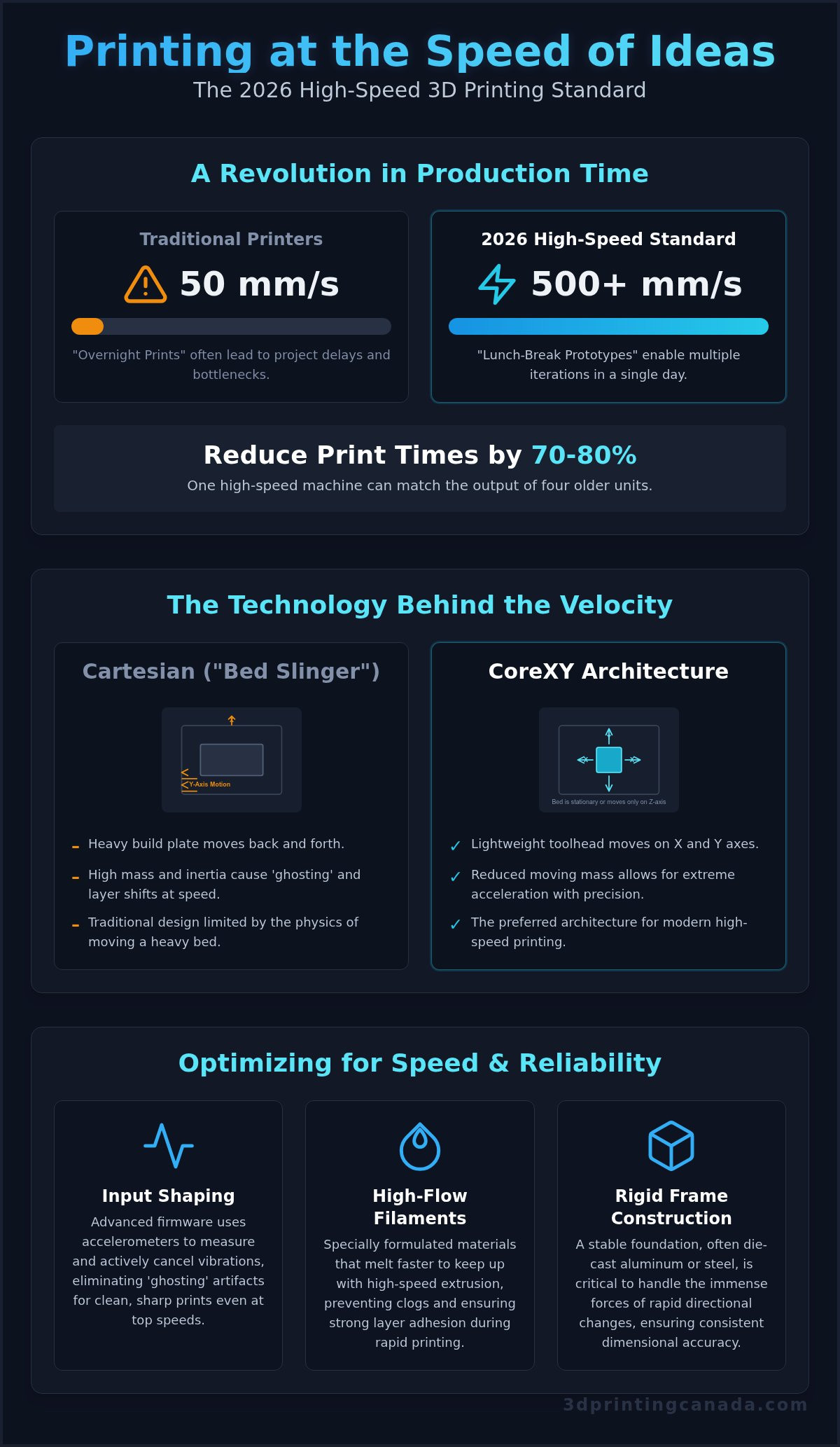
For years, the 3D printing community accepted a slow pace as the price of precision. In 2026, that compromise has vanished. The industry benchmark for 3D printing speed has shifted dramatically, moving from the traditional 50mm/s to a standard exceeding 500mm/s. This isn't just a minor upgrade. It's a foundational change in how we create. For anyone searching for a fast 3D printer Canada offers, the choice is no longer between quality and velocity; it's about how much time you're willing to save.
Slow printers have effectively become obsolete for professional and high-volume hobbyist use. When your machine can produce a complex geometry in two hours instead of twelve, your business model changes. Canadian small businesses are utilizing this speed to move from "overnight prints" to "lunch-break prototypes." This rapid turnaround allows for multiple design iterations in a single workday, drastically reducing the time to market for new products. You can now realize a concept in the morning and have a functional part in your hand before the afternoon meeting.
Breaking the Time Barrier
The return on investment for high-speed hardware is easy to calculate, helping you organize a more profitable workshop. If a machine prints 80% faster, it's essentially doing the work of four older units. This efficiency is why finding a reliable fast 3D printer Canada wide has become a priority for engineering firms and local makers alike. Artists can now produce complex sculptures in a fraction of the time, while engineers can test three different tolerances before the sun goes down. The psychological barrier of "will this print fail overnight?" is replaced by the confidence that you'll have the result by the time you finish your coffee.
The Evolution of 'Out-of-the-Box' Performance
We've moved past the era of DIY "speed-benchy" tuning where users spent weeks tweaking firmware to shave off a few minutes. Today, speed is a factory-optimized feature. Machines arrive ready to hit 500mm/s with the push of a button. This shift places a massive emphasis on reliability. Velocity is useless if the machine shakes itself apart or the nozzle clogs constantly. Modern interfaces now manage the complex physics of high-speed movement automatically, ensuring every layer hits the centre of the build plate with pinpoint accuracy. At 3D Printing Canada, we see this transition daily. Our repair services and stock of Bambu Lab accessories ensure that these high-performance machines stay at peak efficiency, proving that speed and dependability must go hand in hand.
The Technology Behind the Velocity: CoreXY and Input Shaping
Speed in 2026 isn't just about pushing motors to their limits. It's about mastering the physics of motion. When you're looking for a fast 3D printer Canada makers can rely on, you're actually looking for a machine that manages inertia and vibration with surgical precision. The shift toward higher velocity has been driven by a combination of clever mechanical arrangements and sophisticated software that compensates for the physical realities of moving a toolhead at 500mm/s.
CoreXY vs. Cartesian: A Speed Comparison
Traditional Cartesian printers, often called "bed slingers," move the entire build plate along the Y-axis. As your print grows, so does the mass being thrown back and forth. This creates a massive amount of momentum that leads to "ghosting" or layer shifts at high speeds. CoreXY designs solve this by keeping the bed stationary or moving it only on the Z-axis. Two stationary motors work together via a complex belt system to move a lightweight toolhead. CoreXY is the preferred architecture for high-speed FDM.
By reducing the moving mass, these machines can accelerate faster without losing accuracy. A rigid frame, often made of die-cast aluminium or heavy-duty steel, provides the stable foundation needed to handle these forces. If your frame flexes, your print quality suffers. This structural integrity is a key focus in 3D Printing Sector Performance in 2026, as manufacturers prioritize build quality to match their high-speed claims.
Software Magic: Klipper and Modern Firmware
The brain of the printer has evolved just as much as the bones. Modern firmware like Klipper uses high-performance microprocessors to calculate movements far in advance. The standout feature here is Input Shaping. By using accelerometers to measure the natural resonant frequency of the printer, the software can "predict" vibrations and send counter-signals to the motors. It's essentially noise-cancelling technology for your printer's motion system, which eliminates the ringing patterns that used to plague fast prints.
Consistent extrusion is the final piece of the puzzle. Pressure Advance ensures that the flow of plastic matches the speed of the toolhead. When the nozzle accelerates, the firmware increases pressure; when it slows down for a corner, it retracts just enough to prevent oozing. Managing these variables requires a deep understanding of your hardware. If you're struggling to dial in these settings, our team at 3D Printing Canada can help you optimize your machine for peak performance. Integrated AI is also becoming a standard, monitoring the first layer in real-time to ensure that your high-speed projects don't fail before they've truly started.
Selecting the Best High-Speed 3D Printer in Canada
Picking a fast 3D printer Canada makers can trust involves more than just looking at a spec sheet. In 2026, the market has matured into two distinct categories: enclosed workhorses and open-frame speedsters. While velocity is the main draw, you need to consider how build volume and material compatibility fit into your specific workflow. A machine that prints at 600mm/s is only a "time-saver" if it can reliably produce the parts you actually need without constant intervention.
Bambu Lab has fundamentally shifted expectations across the country, making high speed the default rather than a modification. However, brands like Creality and Flashforge have evolved rapidly, bringing Klipper-based speeds to the budget-conscious maker. This competition is great for you. It means you can now find a machine that hits the 2026 speed benchmarks regardless of your experience level or budget. Whether you're running a professional design firm or a weekend hobby shop, the right choice depends on your primary materials and available space.
Enclosed Workhorses for Engineering Materials
Thermal management is the biggest hurdle when printing at high velocities. If you're using materials like ABS, ASA, or polycarbonate, an enclosure isn't optional; it's a requirement. The Bambu Lab P1S and X1E models have become the standard for Canadian professionals because they maintain a stable internal temperature, which prevents warping during rapid cooling. These machines are designed for high-duty cycles, meaning they can handle back-to-back prints without losing accuracy. To keep these systems running smoothly, check out our guide on Bambu Lab accessories Canada for the latest hotends and maintenance kits. Having local access to spares is the best way to ensure your high-speed production never grinds to a halt.
Open-Frame Speedsters for PLA and PETG
If your projects mostly involve PLA, PETG, or TPU, an open-frame printer like the Bambu Lab A1 or A1 mini offers incredible value. These machines are perfect for rapid prototyping where you need to see a physical model quickly. They're generally easier to maintain and have a smaller footprint, which is a major plus for tight Canadian workshops. The trade-off is often noise; high-speed cooling fans and rapid motor movements can be quite loud in a small room. Brands like Creality have also stepped up, integrating vibration compensation into their latest models to ensure that even their most affordable fast 3D printer Canada offerings deliver clean results. Focus on your primary material choice first, then select the frame that supports it.
Optimizing for Speed: Filaments and Maintenance
Owning a fast 3D printer Canada makers use for high-volume production is like driving a high-performance vehicle. You can't just use standard fuel and expect to break records. Most standard filaments fail when pushed beyond 300mm/s because they simply cannot melt fast enough to keep up with the toolhead. This leads to underextrusion, where the printer "starves" for plastic, resulting in brittle parts and visible gaps. To maintain quality at velocity, you must balance your nozzle temperature with the volumetric flow limits of your hotend.
Speed also places immense physical stress on the machine's moving parts. The rapid changes in direction required for high-speed printing create vibrations that can loosen bolts and stretch belts over time. Keeping your machine in peak condition requires a more proactive approach to maintenance than older, slower models. If you ignore the mechanical health of your printer, the "speed" you paid for will quickly turn into a source of failed prints and wasted material.
Choosing High-Speed Filaments
The secret to successful rapid printing lies in the melt-zone. High-flow (HF) filaments are engineered with additives that help them liquify and solidify much faster than traditional plastics. High-speed printing requires filaments with higher thermal conductivity to ensure the core of the material reaches the proper temperature during its millisecond-long stay in the heater block. When you are sourcing PLA filament Canada suppliers offer, specifically look for "High-Speed" or "HF" labels to ensure your extrusion remains consistent at 500mm/s.
Preventative Maintenance for Fast Printers
Friction is the enemy of velocity. You should clean your carbon rods and lubricate your linear rails every few weeks if you are printing daily. High-speed machines often utilize hardened steel nozzles because standard brass versions can wear down quickly under the high pressure of rapid extrusion. Check your belt tensioning regularly; a loose belt at high acceleration will cause immediate layer shifts. For complex mechanical issues or deep-system calibrations, don't hesitate to reach out for professional 3D printer repair services Canada experts provide. Keeping your hardware tuned is the only way to guarantee long-term accuracy. Shop our collection of high-flow filaments and maintenance kits to keep your workshop running at full throttle.
The 3D Printing Canada Advantage: Local Support for High-Speed Tech
Investing in a fast 3D printer Canada makers can depend on is a massive step toward maximizing your productivity. However, the hardware is only half the battle. When you're pushing a machine to its physical limits at 500mm/s, the need for reliable support becomes critical. Buying from a local Canadian retailer ensures that you aren't left stranded when a component wears out or a firmware update causes a hiccup. We understand the unique challenges of the Canadian maker landscape, from the dry winter air that affects filament storage to the logistics of getting parts across the provinces without surprise customs fees or duties.
Our commitment to the community goes beyond just selling boxes. We maintain a comprehensive stock of the latest high-speed accessories and spares, ensuring that your downtime is measured in hours, not weeks. Fast national shipping means that whether you're on the East Coast or in the Prairies, your critical components arrive quickly. This local availability is the backbone of a resilient supply chain for small businesses and hobbyists alike. You need a partner who understands that a broken belt or a clogged high-flow nozzle isn't just a nuisance; it's a stop in production.
Expert Repair and Technical Services
High-speed hardware requires a specialized touch. The complexities of CoreXY belt paths and resonance compensation mean that traditional troubleshooting often falls short. Our technicians specialize in high-speed hardware maintenance, providing expert 3D printer repair services that keep your equipment at peak performance. By utilizing a local Canadian service centre, you avoid the massive costs and risks associated with shipping heavy machinery across international borders for complex repairs. We focus on rapid part replacement and precise calibration so you can get back to creating as soon as possible. Our team has the technical grounding to diagnose issues that are unique to the high-velocity 2026 standard.
Your Partner in the 2026 Printing Revolution
Navigating the transition from slow, traditional printing to the high-velocity standards of 2026 can be daunting. Our team is here to provide the reliable advice and technical grounding you need to make the switch successfully. We don't just sell tools; we offer a partnership that values your creative success. As you expand your workshop, you might find that high-speed printing is just the beginning. Many of our customers use their increased capacity to take on more complex projects involving reverse engineering and digital archiving. You can explore our full range of 3D scanners Canada for the latest technology to complement your rapid prototyping workflow. Let's work together to push the boundaries of what's possible in your studio or office.
Step into the Future of High-Speed Creation
The 2026 standard for 3D printing is clear; speed and precision are now inseparable. By embracing CoreXY architecture and high-flow filaments, you can transform your workflow from days into hours. Finding the right fast 3D printer Canada offers is the first step toward reclaiming your time and scaling your creative output. Remember that the best hardware is only as good as the support behind it. Reliable maintenance and a steady supply of parts are essential to keep those high-velocity motors running smoothly.
Whether you're looking for a deep inventory of Bambu Lab accessories, nationwide Canadian shipping, or expert 3D printer repair services, we're here to help you stay ahead of the curve. Our team is dedicated to providing the technical grounding and local parts you need to keep your workshop running at peak velocity. Don't let outdated technology or long international wait times slow your progress. We have the tools and the expertise to help you organize a more efficient studio and get the most out of your machines.
Shop the Latest High-Speed 3D Printers at 3D Printing Canada and start realizing your projects faster than ever. We're excited to see what you build next.
Frequently Asked Questions
What is considered a 'fast' 3D printer in 2026?
In 2026, a fast 3D printer Canada makers look for typically hits speeds of at least 500mm/s with accelerations reaching 20,000mm/s² or higher. This is a massive leap from the 50mm/s standard that dominated the industry just a few years ago. Speed is now defined by the machine's ability to maintain these velocities throughout a print without losing dimensional accuracy or surface finish quality.
Do I need special filament for high-speed 3D printing?
You absolutely need high-flow filaments to get the most out of your high-speed machine. Standard PLA often fails to melt quickly enough when pushed past 300mm/s, leading to brittle layers and underextrusion. High-flow (HF) filaments are engineered with better thermal conductivity, allowing them to liquify almost instantly in the hotend. This ensures a consistent volumetric flow rate that can keep up with rapid toolhead movements.
Are fast 3D printers less reliable than slower models?
Modern fast printers are highly reliable because they are engineered from the ground up to handle intense physical forces. While older machines might shake apart at these speeds, 2026 models use rigid frames and sophisticated firmware like Klipper to stay stable. They do require more frequent maintenance of moving parts, but the "out-of-the-box" reliability of a premium fast 3D printer Canada hobbyists use is actually superior to older DIY designs.
Can I upgrade my old 3D printer to be fast?
You can upgrade an older machine with Klipper firmware and a high-flow hotend, but you'll hit a physical ceiling quickly. Most older "bed slingers" have heavy build plates that create too much momentum for extreme speeds. While you might double your current speed, you won't match the 500mm/s performance of a dedicated CoreXY system. It's often more cost-effective to invest in a purpose-built machine for true high-speed production.
How does Input Shaping improve 3D print quality at high speeds?
Input Shaping acts like noise-cancelling technology for your printer's motion system. It uses accelerometers to measure the natural vibrations of the machine and then sends counter-signals to the motors to cancel those frequencies out. This process effectively eliminates "ghosting" or "ringing" on the surface of your prints. It allows you to maintain incredible detail even when the toolhead is flying across the build plate at record speeds.
What is the best high-speed 3D printer for a beginner in Canada?
The Bambu Lab A1 series is currently the top choice for beginners who want speed without the steep learning curve. These machines offer a "plug-and-play" experience with automatic calibration and high-speed presets right out of the box. Buying through 3D Printing Canada ensures you have access to local support and accessories. It's the most accessible way to start rapid prototyping without needing to become a firmware expert first.
Does high-speed printing use more electricity?
High-speed printing doesn't typically lead to a noticeable increase in your electricity bill. While the motors and heaters work harder to maintain high temperatures and rapid movements, the total print time is reduced by 70% or more. Because the machine is running for a much shorter duration, the total energy consumption per part often remains similar to, or even lower than, a slow print that takes all night to finish.
How often should I maintain a high-speed CoreXY printer?
You should perform basic maintenance every 100 to 150 hours of print time or roughly once a month for daily users. This involves cleaning carbon rods with isopropyl alcohol, lubricating linear rails, and checking belt tension. High-speed movements place more stress on these components than traditional printing. Proactive care prevents premature wear and ensures that your machine continues to deliver the precision you expect at high velocities.