
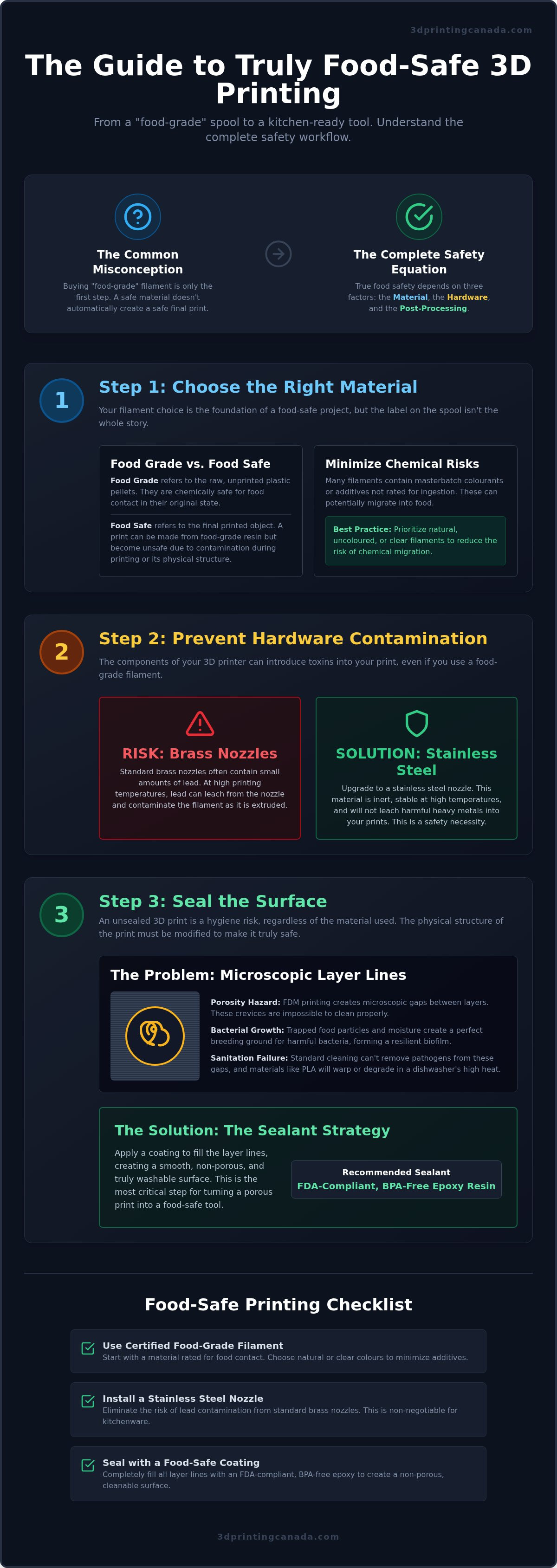
A spool of food safe 3D printer filament is only one-third of the safety equation; loading it into your printer doesn't automatically make your project kitchen-ready. If you think the material alone guarantees a non-toxic result, you might be unknowingly inviting bacteria and heavy metals to the dinner table. It's a common trap for makers who realize the potential of custom kitchenware but don't yet see the microscopic risks hidden in those porous layer lines.
You want the creative freedom to print custom tools without worrying about toxic leaching or germs. We understand that uncertainty. It's hard to feel confident when Health Canada regulations feel broad and online advice is often contradictory. This guide promises to clear the air by providing a validated, professional workflow for achieving truly safe results in your home or shop.
We'll explore why your choice of material is just the beginning. You'll learn why swapping to a stainless steel nozzle is a safety necessity, how to interpret material certifications, and which post-processing sealants are required to turn a porous print into a food-safe tool.
Key Takeaways
- Understand the critical difference between "food grade" raw materials and a finished print, ensuring you use food safe 3D printer filament correctly.
- Learn why microscopic layer lines are the primary hygiene hazard and why porous surfaces require specific post-processing to prevent bacterial growth.
- Identify hardware contamination risks like lead leaching from brass nozzles and discover why stainless steel upgrades are essential for kitchen-ready parts.
- Explore the "Sealant Strategy" to effectively bridge layer gaps using FDA-compliant, BPA-free epoxies for a truly washable finish.
- Recognize why choosing natural or clear filaments over those with masterbatch colourants can reduce the risk of chemical migration in your projects.
The "Food Safe" Label: What It Actually Means (and What It Doesn’t)
Walk into any Canadian maker space and you'll likely see spools of food safe 3D printer filament on the shelves. It's a tempting label, but it's often the most misunderstood part of the hobby. Buying a filament made from FDA-approved materials is a great start, but it isn't a "get out of jail free" card for kitchen safety. You have to look at the entire process from the spool to the dinner plate to truly understand the risks.
Food Grade vs. Food Safe: The Crucial Difference
Think of "food grade" as a rating for the raw ingredients. It means the resin pellets used to make the filament are chemically safe for food contact in their original state. However, "food safe" refers to the final printed object. A print can be made from food-grade resin but still be unsafe due to how it was produced. When you melt filament at high temperatures, you risk introducing chemical changes or picking up contaminants from your printer's hardware.
The physical structure of a 3D print is the biggest hurdle. Even if the plastic is non-toxic, the FDM process creates microscopic gaps between layers. These tiny crevices lead to significant 3D printing food safety concerns because they trap moisture and organic matter, creating a perfect breeding ground for bacteria that a standard rinse won't fix.
Regulatory Standards for Canadian Makers
In Canada, the regulatory environment is unique. As of August 2026, Health Canada and the Canadian Food Inspection Agency (CFIA) do not provide specific pre-market certifications for 3D printed items. Instead, these products fall under the Canada Consumer Product Safety Act (CCPSA). This act puts the burden of proof on you, the maker. If you intend to sell printed kitchenware, you're responsible for ensuring the product doesn't leach harmful chemicals.
Migration testing is the gold standard here. It measures how much of the plastic's chemistry "migrates" into food over time. Don't be fooled by an "FDA Compliant" label on a spool of PLA. While the resin might be safe, it often can't handle the heat of a Canadian dishwasher. The high temperatures can cause the plastic to warp and release chemicals trapped within the polymer matrix, rendering the "safe" label useless.
Avoid the marketing trap of equating "non-toxic" with food safety. Many filaments are safe to handle or use for toys, but they contain masterbatch colourants or additives that aren't rated for ingestion. Always prioritize natural, uncoloured filaments if you want to minimize chemical risks in your kitchen projects. Being a responsible maker means looking past the sticker on the box and understanding the science behind the print.
Layer Lines and Bacteria: The Hidden Hygiene Hazard
Myth: "If I wash it with soap, it's clean." Reality: Porous layer lines trap microscopic food particles that no sponge or brush can reach. Even if you're using a certified food safe 3D printer filament, the physical geometry of an FDM print is a natural enemy of hygiene. FDM printing works by stacking layers of melted plastic, which creates a "stair-step" effect on the Z-axis. These micro-crevices are the perfect size for starches, fats, and proteins to lodge themselves. Once inside, they become a feast for pathogens.
The Porosity Problem in FDM Printing
The gaps between layers aren't just a cosmetic issue. They create a massive surface area that is impossible to fully sanitize. Your print settings play a huge role here. A lower layer height might look smoother, but it actually increases the number of crevices where bacteria can hide. A biofilm is a resilient community of microorganisms that attaches to a surface and protects itself with a slimy, glue-like substance, making it nearly impossible to remove from the deep ridges of a 3D print. Recent University of Alberta research on food safety confirms that these bacterial colonies can be incredibly difficult to dislodge from 3D printed surfaces, even with aggressive scrubbing.
Cleaning and Sanitation Challenges
The biggest hurdle for Canadian makers is the lack of heat resistance in common materials. Most kitchen sanitation requires temperatures above 60°C to kill bacteria effectively. Standard PLA begins to soften at 50°C. Even when using a high-quality food safe 3D printer filament, putting your print in a dishwasher often results in a warped, ruined mess. If the plastic survives the heat, harsh chemical cleaners can leach into the porous material, leaving behind toxic residues that could contaminate your next meal.
For these reasons, categorize your projects by risk level to stay safe:
- Low Risk: Single-use items like cookie cutters for dry dough. These have minimal contact time and don't involve wet, protein-rich foods.
- High Risk: Reusable items like bowls, spoons, or travel mugs. These hold moisture and organic matter for long periods and are much harder to keep clean.
If your hardware isn't extruding consistently, it can create even larger gaps in your print walls that harbour germs. Our 3D printer repair services can help you dial in your settings to ensure your prints are as dense and uniform as possible. While no raw FDM print is perfectly hygienic, proper calibration is your first line of defence.
Beyond the Filament: Nozzles, Extruders, and Toxic Contamination
Even the highest quality food safe 3D printer filament can't protect you from a contaminated machine. Most makers forget that the filament is just one part of a complex chemical journey. As the plastic travels from the spool through the extruder and out the nozzle, it touches several components that can introduce heavy metals or toxic chemicals. If you're using the same printer for industrial carbon fibre parts and kitchen tools, you're likely cross-contaminating your "safe" prints without realizing it.
The Case for Stainless Steel Nozzles
Standard brass nozzles are a major red flag for food safety. Brass is often alloyed with small amounts of lead to make it easier to machine; as the filament rubs against the nozzle walls, microscopic traces of that lead wear off into your print. Stainless steel is the gold standard because it's lead-free and significantly more wear-resistant. For those running high-performance machines, checking out Bambu Lab accessories Canada is a smart move to find hardened or stainless steel hot ends that won't compromise your health.
Don't ignore the hidden components like PTFE lining in your heat break. When temperatures climb, especially if you're printing materials like PETG that require more heat, these tubes can release toxic off-gassing. Transitioning to an all-metal hot end helps eliminate this risk. It's also worth considering a dedicated hot end assembly used exclusively for food-related projects. This prevents "ghosting," where remnants of industrial filaments like ABS or nylon mix with your food safe 3D printer filament.
Extruder Maintenance and Hygiene
Mechanical hygiene is just as important as material choice. Old filament residue can sit in the "dead zones" of a nozzle for weeks, slowly leaching into every new print. Professional 3D printer repair services Canada can ensure your hardware is properly deep-cleaned and calibrated to avoid these issues. A technician can spot build-up in the extruder gears that a casual hobbyist might miss.
Beyond the nozzle, keep an eye on your extruder lubricants. Standard machine grease and oils are often toxic and shouldn't be anywhere near the filament path. Ensure your drive gears are clean and that no excess oils are migrating onto the plastic as it's fed into the hot end. A clean, well-maintained machine is the only way to ensure your kitchen prints stay as pure as the material on the spool.
How to Make Your Prints Truly Food Safe: Coatings and Best Practices
Since layer lines are the primary hygiene hazard, the "Sealant Strategy" is the most effective way to cross the finish line. Even if you print with a high-quality food safe 3D printer filament, the surface remains porous. Coating your print in a food-grade epoxy resin creates a glass-like barrier. This fills the micro-crevices we discussed earlier, making the surface smooth enough to be cleaned with standard dish soap and water.
Selecting a Food-Safe Epoxy Resin
Not all resins are equal. Look for epoxies explicitly labelled as "FDA-compliant" and "BPA-free." These are formulated to be inert once they have fully cured, meaning they won't leach chemicals into your food. Self-levelling resins are your best friend here. They naturally flow into the low spots of your print, smoothing out the "stair-step" texture of the layers without requiring excessive manual intervention.
Safety is paramount during the application. When working with epoxies in your home workshop, always use a respirator and gloves. Ensure your workspace is well-ventilated to handle the fumes during the mixing and application stages. It's a small price to pay for a professional, safe result.
Step-by-Step Coating Process for 3D Prints
Follow these steps to ensure a professional, safe finish for your kitchen tools:
- Step 1: Sanding. Use a fine-grit sandpaper, typically around 220 to 400 grit, to lightly scuff the surface. This creates a mechanical grip for the resin to hold onto. Don't sand so deep that you compromise the structural integrity of the walls.
- Step 2: Application. Apply the resin in thin, even coats. Using a foam brush helps prevent bubbles and ensures you don't lose the fine details of your print by applying the material too thickly.
- Step 3: Curing. Patience is key. While some resins feel dry in hours, they often require 72 hours or more to fully cure and finish off-gassing. Never let food touch the surface until this period is over.
Even the best coatings aren't permanent. Over time, knives or abrasive sponges can create micro-scratches in the epoxy. Once the seal is compromised, bacteria can find a way back in. Inspect your 3D printed kitchen tools regularly. If you see chips, deep scratches, or delamination, it's time to retire the tool and print a fresh one. Safety is a continuous process, not a one-time fix.
Ready to start your next kitchen project? Browse our full range of specialized filaments to find the perfect base material for your food-safe designs.
Choosing the Right Materials: Safe Options for Your Kitchen Projects
Selecting the right material is the foundation of the safety workflow we've established. While we've discussed how hardware and coatings play a role, the chemical makeup of your spool is where the journey begins. Not every food safe 3D printer filament is created equal. Some materials are inherently more stable, while others rely on additives that could migrate into your food if the print isn't properly sealed.
PLA: The Bio-Based Option
PLA is often the first choice for makers because it's derived from renewable resources like corn starch. It's generally non-toxic and easy to print, but it has a major drawback: low heat resistance. A PLA cookie cutter will warp if you try to clean it with hot water. If you choose PLA, stick to "Natural" versions. These spools lack the masterbatch colourants and heavy metal pigments used to create bright reds or deep blues. Be wary of modern "High-Speed" PLA blends. These often contain secret flow enhancers and additives designed for fast printing that haven't been vetted for food contact.
PETG and PP: The Industrial Standards
PETG is the workhorse of the 3D printing world and is chemically similar to the plastic used in water bottles. It's favoured for its durability and better temperature resistance compared to PLA. Polypropylene (PP) is another excellent alternative; it's naturally food-safe, chemically inert, and frequently used in Tupperware. However, PP is notoriously difficult to print due to poor bed adhesion and extreme warping. You can find high-quality versions of these materials in our 3D printer filament Canada guide, which helps you navigate the best brands available locally.
The biggest hidden danger in any filament is the "masterbatch" colourant. These are concentrated pigments added to the raw resin. Even if the resin is food-grade, the dyes might not be. This is why clear or natural filaments are always the safer bet for kitchen projects. To be certain, always request and read the Material Safety Data Sheet (MSDS) for your specific brand. Look closely at Section 3 for chemical composition and Section 11 for toxicological info. If you see "proprietary" chemicals or warnings about skin irritation, it's a sign to keep that material away from your food.
Before you start your first kitchen-related project, run through this final safety checklist:
- Is your printer equipped with a lead-free stainless steel nozzle?
- Have you verified the MSDS for your natural or clear filament?
- Is your workspace clean and free from industrial dust or residue?
- Do you have an FDA-compliant epoxy ready for the sealing stage?
By following these steps, you're not just making a cool gadget; you're ensuring the safety of everyone who uses it. 3D printing in the kitchen is an empowering tool for any maker, provided you respect the science behind the plastic.
Ready to Print Your Next Kitchen Innovation?
You now know that choosing a food safe 3D printer filament is only the foundation of a healthy workflow. Truly safe prints require a combination of lead-free stainless steel hardware, dedicated maintenance, and the right food-grade sealants to eliminate bacterial traps. By moving beyond the "food grade" label and focusing on a validated process, you can create functional tools that are both creative and responsible.
We're here to help you get every detail right. Browse our selection of high-quality filaments and food-safe hardware upgrades today! Our team provides expert technical support for all your hardware needs, backed by our dedicated repair centre and fast shipping across Canada. Whether you need a stainless steel nozzle for your Bambu Lab machine or a spool of natural PETG, we have the stock and the expertise to support your success.
Take your kitchen projects to the next level with confidence. We can't wait to see what you create. Happy printing!
Frequently Asked Questions
Is PLA filament actually food safe for cookie cutters?
PLA is generally considered low risk for single-use items like cookie cutters, but it isn't inherently food safe. While the raw resin is often bio-based, the final print has porous layer lines that trap dough and bacteria. If you use it, stick to natural, uncoloured filament and treat it as a disposable tool. For repeated use, you must apply a food-grade sealant to ensure no organic matter stays trapped in the crevices.
Can I put 3D printed items in the dishwasher if they are food safe?
No, you should never put 3D printed items in a dishwasher. Most common filaments, including PLA and even some PETG, have a low heat deflection temperature. The high heat of a Canadian dishwasher cycle will warp or melt your print. Additionally, the harsh detergents can degrade the plastic or seep into the porous layers. Always hand wash your kitchen prints with lukewarm water and mild soap to maintain their shape.
Are brass nozzles safe for 3D printing food-contact items?
Standard brass nozzles are not recommended for food-contact items because they often contain trace amounts of lead. As the food safe 3D printer filament passes through the hot end, it can pick up microscopic lead particles from the internal walls of the nozzle. To eliminate this risk, upgrade to a stainless steel nozzle. Stainless steel is lead-free, more durable, and the industry standard for maintaining the purity of your prints during the extrusion process.
What is the best coating to make a 3D print food safe?
A food-grade, FDA-compliant epoxy resin is the best coating for sealing 3D prints. These resins are specifically formulated to be BPA-free and non-toxic once fully cured. They work by filling in the microscopic gaps between layer lines, creating a smooth, non-porous surface that is easy to sanitize. Ensure you follow the manufacturer's instructions for mixing and curing times, as the coating must be completely inert before it touches any food surfaces.
Does Health Canada regulate 3D printed food containers?
Health Canada does not have specific regulations or a pre-market approval process for 3D printed food containers. Instead, these items are covered under the broader Canada Consumer Product Safety Act. This means the responsibility lies with the maker to ensure the product is safe for human health. If you plan to sell these items, you're legally obligated to ensure they don't leach harmful chemicals or harbour dangerous levels of bacteria in your customers' kitchens.
Is PETG better than PLA for kitchenware?
PETG is generally better for kitchenware because it offers superior chemical resistance and higher heat tolerance than PLA. It's less likely to warp during cleaning and is more durable for functional tools like measuring cups or handles. However, PETG still suffers from the same porosity issues as any FDM print. Regardless of which food safe 3D printer filament you choose, you still need to use a stainless steel nozzle and apply a proper sealant.
How do I clean a 3D printed object safely?
Clean your 3D printed objects using lukewarm water and a mild, food-safe dish soap. Avoid using abrasive sponges that could scratch the surface and create new hiding spots for germs. Since you can't use high heat for sanitization, focus on thorough rinsing and immediate air-drying. If the object isn't sealed with a food-grade epoxy, it's best to treat it as a single-use item to prevent the build-up of invisible bacterial colonies over time.
Can I use 3D printed parts for hot liquids like coffee?
You should avoid using standard 3D printed parts for hot liquids. Most hobbyist materials soften at temperatures well below a hot cup of coffee, which usually sits around 80°C. Even if the material doesn't melt, the heat can accelerate the migration of chemicals from the plastic or the colourants into your drink. If you need a heat-resistant part, look for high-temperature resins or specialized filaments that require professional-grade annealing processes to stay stable.