Caracol Large-Scale Additive Manufacturing Solutions
for Polymer, Composite, and Metal Production
Manufacturing is evolving beyond the limitations of traditional machining, casting, and tooling. Caracol develops advanced robotic additive manufacturing platforms that enable manufacturers to produce large-scale polymer, composite, and metal components faster, more efficiently, and with greater design freedom.
From pellet extrusion systems for oversized thermoplastic and composite parts to hybrid additive and CNC manufacturing cells and large-format metal additive manufacturing, Caracol delivers configurable production platforms designed for the demands of modern industry.
Whether your objective is accelerating product development, reducing tooling costs, producing end-use components, or expanding manufacturing capacity, Caracol provides scalable solutions that grow with your operation.

Manufacturing Platforms Designed Around Your Process
Caracol offers multiple robotic manufacturing solutions designed to support different production needs, from large-format polymer and composite printing to hybrid additive and CNC workflows and large-scale metal fabrication. Rather than forcing manufacturers into a single machine or process, Caracol builds configurable platforms that can be adapted around part size, material requirements, throughput goals, available floor space, and future automation plans.


Caracol Featured
Explore Caracol Featured
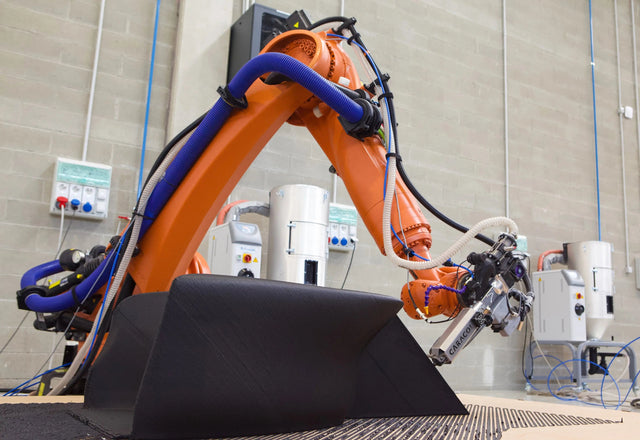
Caracol-AM benefits and features
- Increased precision: Robotic arm 3D printers offer high precision and accuracy, which is critical for creating complex geometries and intricate designs.
- Greater flexibility: The robotic arm's ability to move in multiple axes provides greater flexibility when printing, allowing for more intricate and detailed designs.
- Increased speed: Robotic arm 3D printers can print faster than traditional 3D printers because they can move in multiple axes simultaneously.
- Large print volume: Robotic arm 3D printers can often handle larger print volumes than traditional 3D printers, allowing for the creation of larger or more complex designs.
- Reduced labor costs: Robotic arm 3D printers require less human intervention, reducing the need for manual labor and cutting costs associated with labor.
- Improved consistency: Robotic arm 3D printers can consistently produce high-quality prints, reducing the risk of defects and errors in the printing process.
